
Bright Data is one of those proxy providers that usually comes up when the project is no longer small. If you only need a handful of IPs to test a tool or browse a blocked website, it may feel bigger than what you need.
But if you are collecting public web data at scale, checking search results across different locations, monitoring eCommerce prices, verifying ads, tracking competitors, or building data pipelines for a SaaS product, Bright Data is one of the most complete platforms in the proxy market.
The quick verdict is simple. Bright Data is best for users who need scale, control, compliance, and advanced scraping infrastructure in one place. It is not the cheapest proxy provider, and beginners may need some time to understand the dashboard, zones, pricing models, and product names. But once the setup is clear, the platform gives you a level of control that many budget proxy tools cannot match.
What makes Bright Data different is that it is not just selling proxy IPs. It gives you access to a large proxy network, proxy management tools, Web Unlocker, scraping APIs, browser based tools, ready made datasets, and enterprise data collection services. That makes it useful for technical teams, SEO platforms, affiliate marketers, research companies, AI data teams, cybersecurity teams, and large eCommerce intelligence projects.
For affiliate marketers and SEO professionals, Bright Data is especially useful when you need location accurate data. For example, you may want to check Google rankings from New York, London, Mumbai, Singapore, and Sydney without depending on inaccurate VPN results.
You may also want to monitor competitor landing pages, verify ads in different countries, scrape public SERP data, or compare product pricing across regions. These tasks need more than a random proxy list. They need stable IPs, accurate geo targeting, controlled sessions, and strong success rates.
Bright Data is a premium choice, but it earns that positioning through network size, product depth, and advanced automation. If your scraping work directly affects revenue, reporting, product decisions, or client deliverables, Bright Data is worth serious consideration.
Bright Data Core Infrastructure: Proxy Pool, Locations, and Uptime
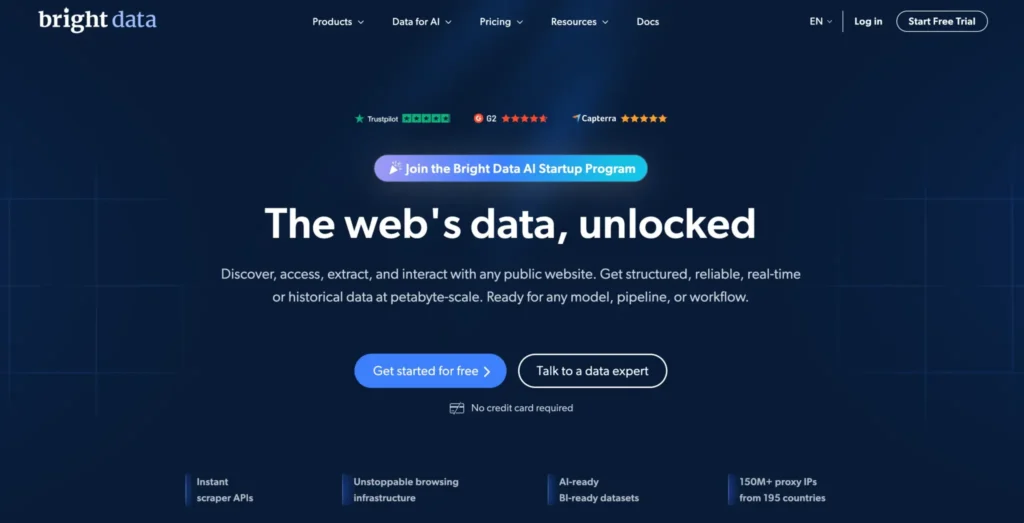
Bright Data’s core strength is its proxy infrastructure. The company advertises more than 400 million monthly proxy IPs across 195 countries. That is far beyond the common “100M plus” proxy claim you see in many older reviews. For a buyer, the important point is not just the headline number. It is what that scale allows you to do.
A large proxy pool helps reduce repeated use of the same IPs, improves location availability, and gives scraping systems more flexibility when target websites become restrictive. If your crawler is checking thousands of product pages, search results, hotel listings, job posts, social pages, or public business directories, the proxy layer needs room to rotate. A small pool can quickly become noisy. A large pool gives you more routing options and a better chance of maintaining clean request patterns.
Bright Data’s residential proxy network is the main attraction here. These IPs come from real peer devices and internet service providers, which makes them look more natural than ordinary server based datacenter IPs. That matters for websites that apply stricter traffic checks. Residential proxies are commonly used for public web scraping, ad verification, SERP tracking, price monitoring, market research, travel fare checks, and localized content testing.
Location control is another major reason businesses choose Bright Data. The platform supports targeting by country, city, state, ZIP code, carrier, and ASN. This is a practical advantage for real data collection. A local SEO tool does not only need “United States” results.
It may need results from Chicago, Dallas, Miami, or Los Angeles. An ad verification team may need to check whether a campaign is displaying correctly in a specific region. An eCommerce pricing tool may need to compare the same product page from different cities because pricing, availability, shipping, and promotions can change by location.
Bright Data also claims 99.99 percent network uptime and a 99.95 percent success rate across its proxy infrastructure. In a normal browsing context, those numbers may not mean much. In data collection, they matter a lot. Failed requests create missing rows, broken dashboards, delayed reports, and higher infrastructure costs. If your system has to retry the same URL five times because the proxy quality is weak, your real cost per successful result increases.
Performance also depends on the type of proxy you choose. Residential proxies are built for trust and location accuracy. Datacenter proxies are built for speed and lower cost. ISP proxies sit between both worlds by combining static residential style trust with better stability. Web Unlocker is designed for the hardest targets where proxy rotation alone is not enough.
Bright Data Product Breakdown: Residential, Datacenter, and Web Unlocker
Bright Data has a large product catalog, but most buyers should start by understanding three core layers: Residential Proxies, Datacenter Proxies, and Web Unlocker. These cover the majority of scraping and data access use cases.
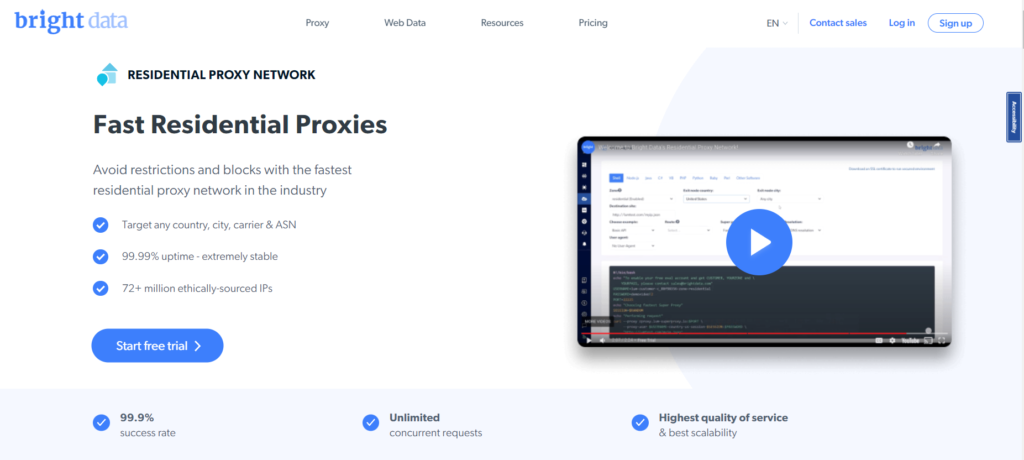
Bright Data Residential Proxies
Bright Data Residential Proxies are designed for websites that are sensitive to datacenter traffic. These proxies route requests through real residential IPs, which makes them better suited for public websites that use stricter bot detection, geo checks, or traffic reputation filters.
The residential proxy network includes more than 400 million monthly IPs across 195 countries. Bright Data also promotes sticky and rotating sessions, free geo targeting, around 0.7 second response time, and a 99.95 percent success rate for residential proxy usage. For scraping teams, that combination is powerful because it gives you both scale and control.
Rotating sessions are useful when your scraper needs to visit many pages and avoid sending too many requests from the same IP. Sticky sessions are useful when the task needs consistency, such as maintaining a shopping session, checking localized results, testing account flows, or browsing a website in a way that should not change identity every few seconds.
Residential proxies are usually the best fit for eCommerce intelligence, SEO rank tracking, ad verification, travel aggregation, social listening, review monitoring, ticketing research, and local market research. They are not always the cheapest option, but they usually provide better access quality for difficult public websites.
Bright Data Datacenter Proxies
Bright Data Datacenter Proxies are built for speed, volume, and cost efficiency. The company lists more than 1.3 million datacenter IPs and supports both shared and dedicated options. These proxies are not tied to home internet connections. They are hosted in data centers, which makes them faster and easier to scale for many scraping tasks.
Datacenter proxies are a good choice when the target website is not heavily protected or when you need a large number of fast requests at a lower cost. Common use cases include crawling public websites, monitoring brand mentions, checking public databases, QA testing, cybersecurity research, and collecting less sensitive market data.
The biggest benefit of datacenter proxies is control. Dedicated datacenter IPs can be kept for ongoing use, which helps when you need predictable routing. Shared datacenter proxies can be useful for general scraping and geo based access when exclusivity is not required.
The limitation is that datacenter IPs are easier for advanced websites to identify. Large eCommerce sites, social media platforms, travel websites, and heavily protected search pages may block or challenge datacenter traffic faster. In those cases, Residential Proxies or Web Unlocker usually make more sense.
Bright Data Web Unlocker as the Advanced Residential Layer
Bright Data does not position “Next Gen Residential Proxies” as a separate product in the same way some proxy companies do. The closest and more powerful Bright Data equivalent is Web Unlocker. This is not just a proxy pool. It is an automated unblocking layer designed to handle blocks, CAPTCHAs, proxy rotation, request retries, browser fingerprinting, headers, and JavaScript rendering.
This matters because many modern websites do not block traffic only based on IP address. They also check browser behavior, cookies, headers, TLS fingerprints, request patterns, JavaScript execution, and session consistency. A normal proxy can change your IP, but it may not solve those deeper checks.
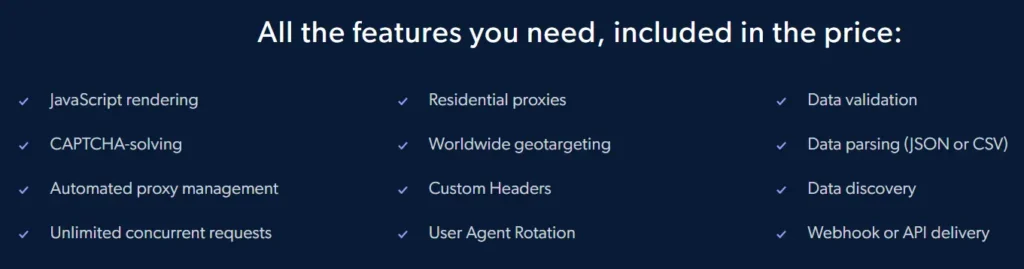
Web Unlocker is made for teams that want clean HTML or JSON from difficult public pages without maintaining complex scraping infrastructure. Instead of manually building proxy waterfalls, retry systems, browser farms, CAPTCHA handling, and fingerprint logic, developers can send requests through Web Unlocker and let Bright Data manage the access layer.
This product is especially useful for eCommerce scraping, travel price tracking, SERP extraction, marketplace monitoring, AI data collection, and websites where normal residential proxies still trigger blocks. It will cost more than raw proxies, but the tradeoff is less engineering work and higher reliability on complex targets.
Bright Data Proxy Features and Technical Specs
| Product | Best For | Network and Coverage | Session Control | Technical Strength | Practical Use Cases |
|---|---|---|---|---|---|
| Residential Proxies | Large scale scraping, local SEO, ad verification, price monitoring | 400M+ monthly residential IPs across 195 countries | Sticky and rotating sessions | Free city, state, ZIP code, carrier, and ASN targeting | SERP tracking, eCommerce scraping, travel fare checks, social listening |
| Datacenter Proxies | Fast scraping and lower cost data collection | 1.3M+ datacenter IPs with shared and dedicated options | Static IP control with shared or dedicated setup | Fast response time, high volume access, lower cost per request | Public website crawling, QA testing, brand monitoring, cybersecurity checks |
| ISP Proxies | Long sessions with residential style trust | 1.3M+ static residential ISP proxies | Keep the same IP for long term use | Static IPs leased from ISPs with strong stability | Account testing, long session scraping, marketplace workflows |
| Web Unlocker | Difficult websites with advanced blocking | Uses Bright Data’s proxy infrastructure with automated unblocking | Managed rotation, retries, CAPTCHA handling, and rendering | Handles browser fingerprints, JavaScript rendering, headers, and blocks | Protected eCommerce pages, SERPs, travel sites, AI data pipelines |
| Mobile Proxies | Mobile first data collection and app testing | Mobile IPs from real carrier networks | Rotating mobile sessions | Better fit for mobile SERP, app, and ad testing | Mobile ads, app research, mobile search results, mobile content checks |
The main takeaway is that Bright Data gives you several routes to the same goal: reliable access to public web data. If you need maximum trust and location precision, Residential Proxies are the natural starting point. If you need speed and lower cost, Datacenter Proxies make more sense. If you need static residential style sessions, ISP Proxies are useful. If the target website is highly protected, Web Unlocker is the stronger option because it handles more than just the IP layer.
This is why Bright Data works well for serious users. It does not force every project into one proxy type. You can match the product to the job, control your setup, and scale from basic scraping to advanced data collection without changing providers.
Bright Data Pricing: Powerful, Flexible, but Not the Cheapest
Bright Data pricing is one of the biggest reasons buyers either choose it confidently or move toward a simpler competitor. This is not a budget proxy provider. It is a premium data collection platform, and the pricing reflects that. The important thing is to judge Bright Data by the cost per successful result, not only the cost per GB or per IP.
For residential proxies, Bright Data uses bandwidth based pricing. The pay as you go residential plan is listed at $8 per GB as the standard rate, with promotional discounts often bringing it lower. At the time of review, Bright Data shows a 50 percent discount on residential traffic, which brings the pay as you go price to $4 per GB. Monthly plans reduce the cost further when you commit to higher usage.
The 141GB plan is listed at $499 per month with discounted pricing of $3.50 per GB, the 332GB plan is listed at $999 per month with discounted pricing of $3 per GB, and the 798GB plan is listed at $1,999 per month with discounted pricing of $2.50 per GB.
That pricing is not low for a casual user, but it makes more sense for businesses that care about targeting depth, uptime, success rate, support, and compliance. If your project is checking 20 keywords manually, Bright Data is probably overkill. If your platform is scraping millions of public product pages, checking local SERPs, verifying ads, or powering a market intelligence dashboard, the higher entry cost can be justified by fewer failed requests and less engineering work.
Datacenter proxy pricing is more flexible. Bright Data offers shared, dedicated, and pay per GB options. Shared datacenter plans start from 10 IPs at $1.40 per IP, while larger plans can bring the rate down to $0.90 per IP. Dedicated datacenter plans start at $2.20 per IP for 10 IPs and scale down with higher volume. The pay per GB datacenter option starts at $0.60 per GB on pay as you go, with larger monthly traffic plans bringing the rate lower. Datacenter proxies are the better fit when speed and cost control matter more than residential trust.
ISP proxies are priced by IP or bandwidth depending on the setup. Shared ISP pricing starts from 10 IPs at $1.80 per IP, while larger plans bring the rate down to $1.30 per IP. Dedicated ISP proxies are more expensive, starting from 10 IPs at $3.50 per IP and scaling down to $2.50 per IP at larger volume. There is also a pay per GB option at $8 per GB. ISP proxies are useful when you need static residential style IPs, long sessions, and better stability than rotating residential proxies.
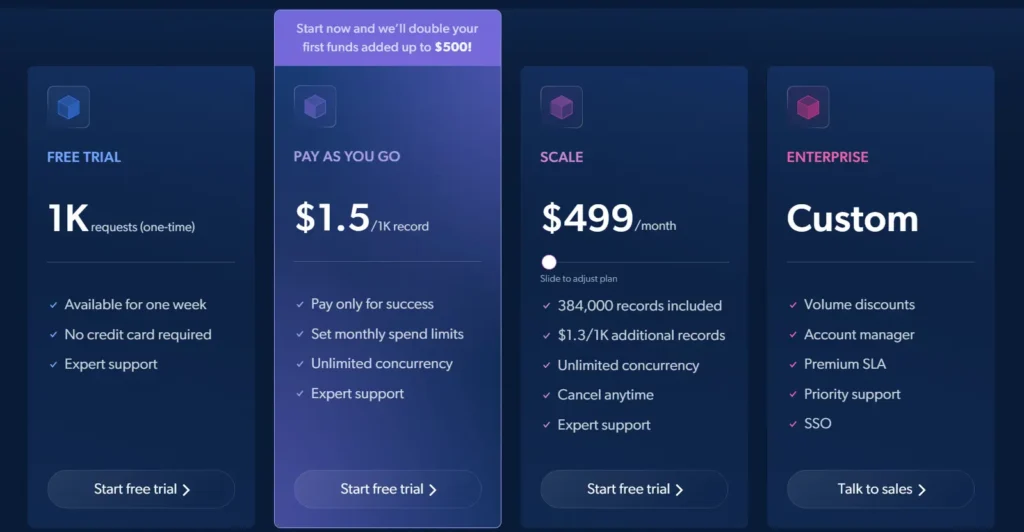
Web Unlocker has a different pricing model because it is not just a proxy product. It is an automated unblocking layer. Bright Data lists a free tier with 5,000 requests per month and no credit card required. Pay as you go pricing is $1.50 per 1,000 requests, and the Scale plan starts at $499 per month with 380,000 requests included and $1.30 per 1,000 additional requests.
| Bright Data Product | Entry Pricing | Pricing Model | Best For |
|---|---|---|---|
| Residential Proxies | Pay as you go listed at $8 per GB, often discounted to $4 per GB | Bandwidth based | Local SEO, price scraping, ad verification, public data collection |
| Datacenter Proxies | Shared from $1.40 per IP, dedicated from $2.20 per IP, pay per GB from $0.60 per GB | Per IP or per GB | Fast scraping, lower cost crawling, QA testing, public database monitoring |
| ISP Proxies | Shared from $1.80 per IP, dedicated from $3.50 per IP, pay per GB from $8 per GB | Per IP or per GB | Static sessions, account testing, stable location based workflows |
| Web Unlocker | Free 5,000 requests monthly, then $1.50 per 1,000 requests | Per successful request | Difficult websites, CAPTCHA heavy pages, JavaScript rendering, anti bot handling |
| Enterprise Plans | Custom pricing | Custom volume based pricing | Large scale scraping teams, SaaS platforms, AI data pipelines, enterprise data operations |
Bright Data vs Competitors: How It Compares With Oxylabs, Decodo, SOAX, and NetNut
Bright Data competes in the same premium category as Oxylabs, but the two platforms feel slightly different. Oxylabs has a strong enterprise proxy and scraping stack, with a residential pool of 175M plus IPs and a very clean product experience. Bright Data feels broader. It has proxies, Web Unlocker, scraping APIs, SERP tools, datasets, archive access, and managed data services. If you want a complete public web data platform, Bright Data has more moving parts. If you want a more focused premium proxy provider, Oxylabs may feel simpler.
Against Decodo, formerly Smartproxy, Bright Data is more powerful but less beginner friendly. Decodo is easier for small teams, affiliate marketers, SEO users, and developers who want residential proxies without heavy setup. Its residential pricing also starts lower, with small plans like 3GB and 10GB available at beginner friendly monthly totals. Bright Data wins when you need deeper targeting, larger infrastructure, enterprise support, Web Unlocker, datasets, and stronger control over scraping workflows.
SOAX is a strong option for users who want flexible proxy access with a cleaner dashboard and granular targeting. It is popular with mid market users who want residential, mobile, ISP, and datacenter access without the full complexity of Bright Data. Bright Data has the edge when the job moves beyond proxies into managed unblocking, scraping APIs, and enterprise data delivery.
NetNut is another serious competitor, especially for residential and ISP style proxies. It offers a strong residential pool, competitive per GB pricing at higher volumes, and a simpler product lineup. Bright Data has a wider platform, more advanced data collection tools, and stronger positioning for companies that need proxies, scraping automation, and ready to use datasets from one provider.
| Provider | Best Strength | Where Bright Data Wins | Where Bright Data May Lose |
|---|---|---|---|
| Oxylabs | Premium proxy infrastructure and enterprise scraping tools | Broader platform with datasets, Web Unlocker, APIs, and archive products | Oxylabs can feel cleaner for proxy focused buyers |
| Decodo | Beginner friendly plans and lower entry pricing | Larger platform, deeper targeting, stronger enterprise stack | Decodo is easier and cheaper for small users |
| SOAX | Flexible targeting and mid market usability | More advanced scraping and data collection infrastructure | SOAX may feel simpler for smaller teams |
| NetNut | Strong residential and ISP proxy pricing at scale | More product depth and stronger managed scraping options | NetNut can be easier to understand for proxy only buyers |
| Webshare | Affordable proxy access and simple setup | Bright Data is much stronger for serious scraping, support, and tooling | Webshare is cheaper for basic proxy needs |
Bright Data Use Cases: Who Should Actually Buy It?
Bright Data is best for buyers who need public web data repeatedly, accurately, and at scale. That includes SEO platforms, eCommerce intelligence tools, travel fare trackers, ad verification systems, brand protection teams, cybersecurity researchers, AI data companies, and large affiliate operations.
For SEO teams, Bright Data is useful for local SERP scraping, rank tracking, keyword monitoring, competitor page checks, and search result testing across countries, cities, and ZIP codes. A normal VPN may show rough location differences, but it is not enough for automated ranking systems or client reporting.
For affiliate marketers, the value depends on how technical your workflow is. If you only publish product reviews and coupon pages, you may not need Bright Data. But if you monitor advertiser landing pages, check SERP volatility, scrape public price data, verify offers by country, or run competitor intelligence at scale, Bright Data can be very useful.
For eCommerce data teams, Bright Data is one of the stronger options. Price monitoring, product availability tracking, review scraping, marketplace research, and catalog enrichment all require consistent access to public pages. When websites display different prices or stock levels by location, Bright Data’s geo targeting becomes a real advantage.
For AI and machine learning teams, Bright Data can support data pipelines through public web data collection, datasets, archive access, and APIs. This is useful for model training, retrieval workflows, market research, entity enrichment, and content analysis.
Bright Data Pros and Cons
Pros:
• One of the largest proxy networks in the market
• 400M plus monthly residential IPs across 195 countries
• Strong geo targeting by country, city, state, ZIP code, ASN, and carrier
• Residential, datacenter, ISP, mobile, and Web Unlocker products
• Web Unlocker reduces work around CAPTCHAs, retries, headers, and fingerprinting
• Strong fit for enterprise scraping, SEO, ad verification, AI data, and eCommerce intelligence
• Good documentation, integrations, dashboard controls, and support options
• Broader platform than most proxy only providers
Cons:
• More expensive than budget proxy providers
• Dashboard and product structure may feel complex for beginners
• Some pricing pages can feel confusing because of different billing models
• Small users may not need the full platform
• Web Unlocker and scraping tools can become costly at high volume
• Best value comes when your project needs serious scale or reliability
Final Verdict: Is Bright Data Worth It?
Bright Data is worth it if your business depends on reliable access to public web data. It is one of the strongest choices for teams that need scale, targeting, proxy variety, automation, and enterprise level control. The platform is especially useful for SEO tools, affiliate intelligence, ad verification, eCommerce scraping, travel data, cybersecurity research, market intelligence, and AI data collection.
It is not the best choice for everyone. Beginners who only need a few proxies may find it too advanced and too expensive. Smaller users may get better value from Decodo, Webshare, IPRoyal, or another lower cost provider. But for serious scraping and business critical data operations, Bright Data remains one of the most complete platforms available.
The best way to choose Bright Data is to match the product to the job. Use Residential Proxies when trust and location accuracy matter. Use Datacenter Proxies when speed and cost matter. Use ISP Proxies when you need static sessions with residential style credibility. Use Web Unlocker when regular proxies are not enough and you want Bright Data to handle blocks, CAPTCHAs, retries, rendering, and fingerprint logic.
Overall, Bright Data is a premium proxy and data collection platform that earns its reputation. It is powerful, flexible, technically mature, and built for teams that cannot afford weak infrastructure. If your scraping workflow has real business value, Bright Data is one of the safest high end choices in the market.