
Decodo has been one of the most recognizable names in the proxy market for years, but there is one important update buyers need to know before comparing plans. Smartproxy has rebranded to Decodo. The product is still aimed at the same core audience: web scrapers, SEO teams, affiliate marketers, ad verification teams, eCommerce researchers, developers, and businesses that need reliable access to public web data without building proxy infrastructure from scratch.
The quick verdict is clear. Smartproxy, now Decodo, is one of the strongest mid-market proxy providers for users who want a balance of large proxy coverage, clean dashboard usability, strong technical features, and more approachable pricing than heavy enterprise platforms like Bright Data or Oxylabs. It is not the absolute cheapest proxy provider, and it may not be the deepest enterprise data platform, but it hits a very useful middle ground.
This is why Decodo has always been popular with SEO and affiliate users. You do not always need a massive enterprise contract just to check local rankings, monitor product pages, verify advertiser landing pages, scrape public SERPs, compare pricing across regions, or run browser automation. What you need is a proxy network that works consistently, supports accurate targeting, integrates with your tools, and does not take days to configure.
Decodo currently positions the platform around 125M+ ethically sourced proxy IPs across 195+ locations. Its residential proxy pool alone includes 115M+ IPs, which puts it well above smaller budget providers and close enough to the premium tier for most real-world scraping projects. That network is backed by residential, datacenter, ISP, mobile, SOCKS5, Site Unblocker, and Web Scraping API products.
For a beginner, Decodo is easier to understand than many enterprise proxy dashboards. For a developer, it still gives enough control through HTTP(S), SOCKS5, rotating sessions, sticky sessions, geo targeting, ASN targeting, proxy credentials, and integrations with common scraping tools. That combination is the main reason Decodo earned its reputation and why Decodo still deserves attention.
Decodo Core Infrastructure: Proxy Pool, Locations, and Reliability
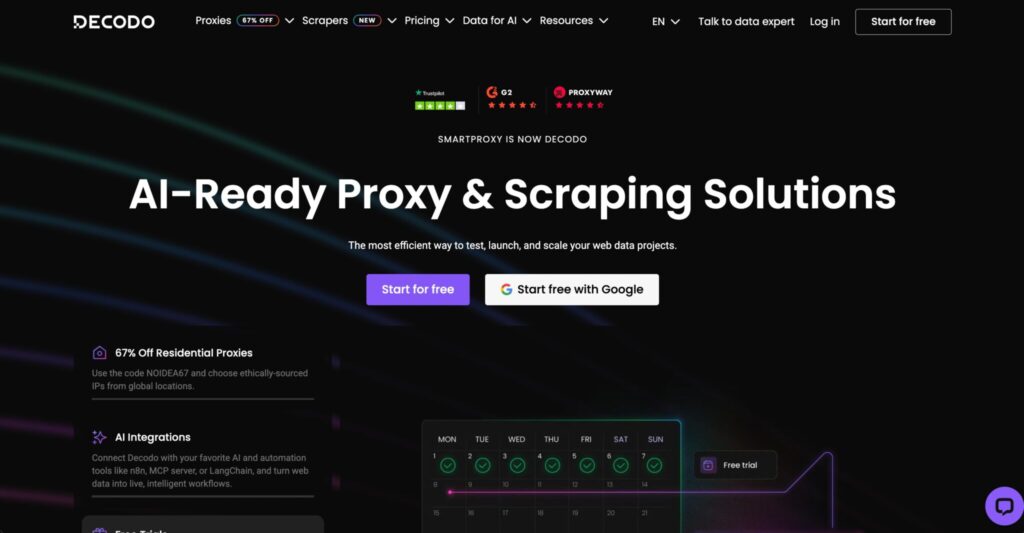
The backbone of Decodo’s current platform is Decodo’s global proxy infrastructure. The provider advertises 125M+ ethically sourced IPs across 195+ locations, with a 99.99% uptime claim across the platform. For serious scraping, those numbers matter because proxy performance is not only about raw speed. It is about whether your requests keep completing when you scale from a few hundred URLs to thousands or millions of public pages.
The residential network is the most important part of the stack. Decodo lists 115M+ residential IPs in 195+ locations, with a 99.92% success rate and average response time under 0.5 seconds. These IPs come from real household devices and local networks, which makes them better suited for websites that are sensitive to datacenter traffic. If a site sees too many requests from obvious server IP ranges, it may return CAPTCHAs, blocks, incorrect location data, or empty pages. Residential proxies reduce that risk when used correctly.
The location targeting is also strong. Decodo supports continent, country, state, city, ZIP code, and ASN-level targeting for residential proxies. This is very useful for SEO and affiliate work because search results, offers, prices, ads, shipping messages, and landing pages often change by location. A rank tracker may need to check Google results from Los Angeles, London, Mumbai, or Toronto. An affiliate marketer may need to verify whether a brand’s offer appears properly in the United States, Canada, the United Kingdom, or India. A price intelligence team may need to see what a customer sees from a specific city, not just a generic country-level IP.
Datacenter proxies serve a different purpose. Decodo’s datacenter product includes 500K+ datacenter IPs, 99.99% uptime, sub-0.3 second average response time, and a 99.94% success rate claim. These proxies are better for speed-focused tasks, API testing, development environments, high-volume crawling, and websites that do not strongly block datacenter traffic. They are usually cheaper and faster than residential proxies, but they do not carry the same real-user trust profile.
Decodo also offers mobile proxies with 10M+ real mobile IPs across 160+ locations and 700+ mobile carriers. These are useful when the target experience is mobile-specific. Mobile ads, app store research, mobile search results, social workflows, and carrier-based testing can behave differently from desktop browsing. For those cases, mobile IPs can provide more realistic data than residential or datacenter proxies.
Decodo Product Breakdown: Residential, Datacenter, and Site Unblocker
Smartproxy’s product lineup under Decodo can be understood in three practical layers. Residential proxies are for authenticity and geo accuracy. Datacenter proxies are for speed and cost control. Site Unblocker is the next-gen proxy layer for websites where normal proxy rotation is not enough.
Decodo Residential Proxies
Smartproxy Residential Proxies, now sold under Decodo, are the best starting point for most scraping, SEO, and affiliate monitoring tasks. They use real residential IPs, which helps requests appear closer to normal user traffic. That makes them useful for public websites that show different results based on IP reputation, region, or browsing pattern.
The 115M+ residential IP pool gives users enough scale for most location-sensitive projects. You can rotate IPs on each request when collecting many pages, or use sticky sessions when a task needs consistency. Sticky sessions are helpful when checking multi-step flows, maintaining a cart, testing localized checkout pages, verifying ads, or collecting data from websites that expect a stable user session.
The protocol support is strong enough for both simple and advanced users. Decodo supports HTTP(S) and SOCKS5, with unlimited concurrent sessions included in residential plans. This makes it easier to plug proxies into Python scripts, Scrapy, Playwright, Puppeteer, Selenium, browser extensions, anti-detect browsers, no-code scraping tools, and custom data pipelines.
For SEO teams, residential proxies are ideal for local rank tracking, SERP scraping, backlink checks, and competitor monitoring. For affiliate marketers, they help verify offer pages, geo redirects, coupon visibility, comparison pages, and advertiser landing pages from different countries. For eCommerce teams, they support price monitoring, review tracking, stock checks, and marketplace research.
Decodo Datacenter Proxies
Decodo Datacenter Proxies are built for users who care about speed, stability, and affordable scale. Decodo lists 500K+ datacenter IPs, shared and dedicated options, HTTP(S) and SOCKS5 support, and sub-0.3 second average response time. That makes this product a practical choice for high-volume scraping where the target website is not extremely sensitive to server-based IPs.
Datacenter proxies are useful for public website crawling, QA testing, uptime checks, data validation, brand monitoring, API testing, and software development environments. They are also a good fit when you need predictable performance and do not want to burn residential bandwidth on easy targets.
The limitation is trust. Datacenter IPs come from cloud or server infrastructure, so some websites can detect them faster. If you are scraping protected eCommerce sites, travel platforms, ticketing pages, or search engines at scale, residential proxies or Site Unblocker will usually be safer. But for clean, fast, and budget-friendly traffic, datacenter proxies are still an important part of the Decodo stack.
Decodo Site Unblocker as the Next-Gen Residential Layer
Decodo does not use the exact product name “Next-Gen Residential Proxies” in the same way some providers do. The closest Decodo equivalent is Site Unblocker. This is an advanced proxy-based solution that goes beyond basic IP rotation.
A standard proxy changes the IP address behind your request. Site Unblocker handles more of the difficult work, including automatic proxy pool rotation, browser fingerprinting, JavaScript rendering, CAPTCHA handling, and anti-bot bypassing. It integrates like a proxy through a single endpoint, but behaves more like a managed access layer for difficult public websites.
This matters because modern anti-bot systems do not only check IP addresses. They analyze headers, cookies, browser fingerprints, request timing, JavaScript behavior, and session consistency. A raw residential proxy may still fail if the request pattern looks unnatural. Site Unblocker is built for cases where you want to send a request and receive usable HTML from a more protected page without maintaining complex scraping infrastructure yourself.
For eCommerce scraping, SERP monitoring, travel fare tracking, marketplace research, and AI data collection, this can save serious engineering time. Instead of writing custom retry logic, rotating fingerprints, managing headless browsers, and solving blocks manually, teams can route harder targets through Site Unblocker.
Decodo Features and Technical Specs
| Product | Best For | Network and Coverage | Session Control | Protocols and Technical Specs | Practical Use Cases |
|---|---|---|---|---|---|
| Residential Proxies | SEO tracking, affiliate checks, price scraping, ad verification | 115M+ residential IPs across 195+ locations | Rotating and sticky sessions | HTTP(S), SOCKS5, unlimited concurrent sessions, country, state, city, ZIP, and ASN targeting | Local SERP scraping, offer verification, eCommerce monitoring, travel data |
| Datacenter Proxies | Fast scraping, testing, automation, low-cost crawling | 500K+ datacenter IPs with shared and dedicated options | Shared or dedicated IP control | HTTP(S), SOCKS5, sub-0.3s average response time, 99.99% uptime claim | Public website crawling, QA testing, API checks, brand monitoring |
| Site Unblocker | Difficult websites with anti-bot systems | Uses Decodo’s proxy infrastructure with automatic pool rotation | Rotating sessions or sticky IPs up to 10 minutes | Browser fingerprinting, JavaScript rendering, CAPTCHA handling, single proxy-style endpoint | Protected eCommerce pages, SERPs, travel sites, marketplace scraping |
| ISP Proxies | Stable sessions with residential credibility | Static IPs from premium ASNs | Static session control | HTTP(S), SOCKS5, sub-0.2s response time, 99.99% uptime claim | Account workflows, social media management, brand protection |
| Mobile Proxies | Mobile-first testing and carrier-based access | 10M+ mobile IPs across 160+ locations and 700+ carriers | Rotating or sticky mobile sessions | HTTP(S), SOCKS5, advanced targeting | Mobile SERPs, app testing, mobile ad verification, social workflows |
The main takeaway is that Smartproxy, now Decodo, has matured beyond a simple residential proxy provider. It now offers a broader data access stack that works for beginners, developers, SEO teams, and growing businesses. Residential proxies handle trust-sensitive tasks.
Datacenter proxies handle fast and affordable workloads. Site Unblocker gives users a stronger option for difficult targets. That product range makes Decodo one of the most practical proxy providers for users who want serious capability without jumping straight into enterprise-only complexity.
Decodo Pricing: Flexible Enough for Small Teams, Strong Enough for Scaling
Smartproxy, now Decodo, has always been popular because it sits between budget proxy sellers and enterprise platforms. The pricing reflects that middle-ground position. It is not as cheap as the lowest-cost providers, but it is much easier to start with than Bright Data or Oxylabs if you are an SEO user, affiliate marketer, developer, or small data team.
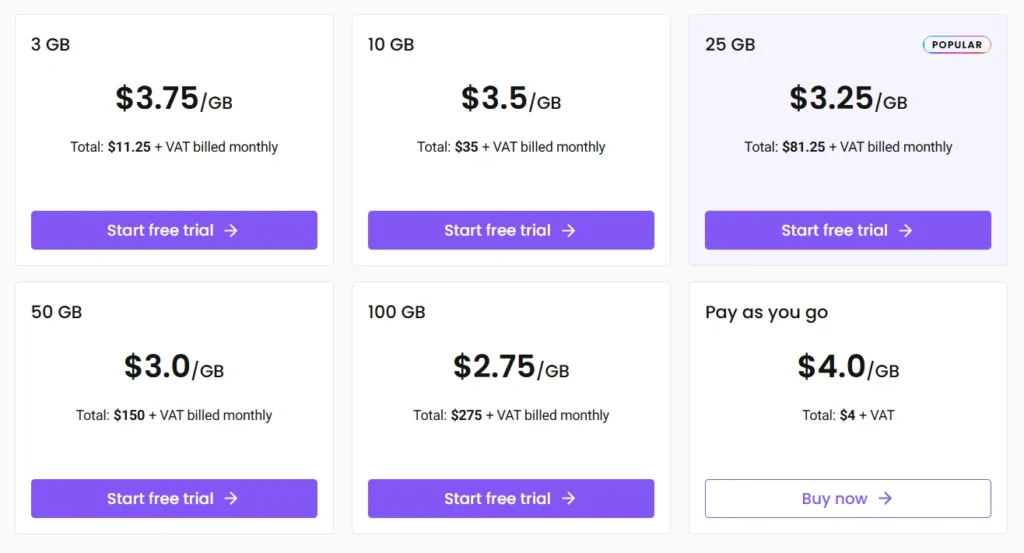
Residential proxies are priced by bandwidth. Decodo’s regular residential plans start with a 3GB plan at $3.75 per GB, billed at $11.25 monthly plus VAT. The 10GB plan drops to $3.50 per GB, the 25GB plan is $3.25 per GB, the 50GB plan is $3.00 per GB, and the 100GB plan is $2.75 per GB. Pay as you go residential traffic is available at $4.00 per GB. Decodo also advertises residential proxies from $2 per GB, which applies to larger scale plans rather than the smallest entry packages.
This makes Decodo useful for buyers who want to test proxies without committing to a large monthly contract. For example, an affiliate marketer checking advertiser landing pages in different countries can start with a smaller residential plan. An SEO agency scraping local SERPs for multiple clients may need a larger package. An eCommerce monitoring tool tracking prices daily will likely need higher bandwidth and should judge Decodo by cost per successful result, not just headline price per GB.
Datacenter proxy pricing is built for speed-focused use cases. Decodo offers pay per IP and pay per GB models. Its public pricing positions datacenter proxies from $0.02 per IP, while bandwidth-based datacenter access starts from small traffic packages such as 10GB at $0.60 per GB in supported locations. Datacenter proxies are usually the best value when the target website is not extremely sensitive to server IP ranges.
Static residential proxies, also called ISP proxies, can be bought through pay per IP or pay per GB models. Decodo advertises ISP proxies from $0.27 per IP on its main pricing menu, while the visible dedicated monthly plans start with 3 IPs at $3.33 per IP, billed at $9.99 plus VAT. ISP proxies are useful when you need a fixed identity with better trust than regular datacenter proxies.
Mobile proxies are priced by bandwidth and Decodo advertises them from $2.25 per GB. The smaller visible mobile plans currently show 2GB at $3.75 per GB, 8GB at $3.50 per GB, and 25GB at $3.25 per GB during promotional pricing. Mobile proxies are more expensive than datacenter proxies, but they are the better choice when you need real mobile carrier traffic for app testing, mobile ad checks, or mobile SERP monitoring.
Site Unblocker is priced separately because it is not a basic proxy product. It includes automated unblocking, proxy rotation, CAPTCHA handling, browser fingerprinting, and JavaScript rendering. Its pay per GB plans start at 1GB for $10 per GB, with lower rates on larger packages. This product is best used for difficult websites where ordinary residential proxies still produce blocks or incomplete pages.
| Decodo Product | Starting Price | Pricing Model | Best Use Case |
|---|---|---|---|
| Residential Proxies | 3GB at $3.75/GB, pay as you go at $4/GB | Bandwidth based | SEO tracking, ad verification, eCommerce scraping, affiliate checks |
| Datacenter Proxies | From $0.02/IP or around $0.60/GB on traffic plans | Per IP or per GB | Fast crawling, QA testing, automation, lower-cost scraping |
| Static Residential Proxies | From $0.27/IP advertised, small dedicated plan from $3.33/IP | Per IP or per GB | Long sessions, account workflows, stable identity |
| Mobile Proxies | From $2.25/GB advertised | Bandwidth based | Mobile SERPs, app testing, mobile ad verification, social workflows |
| Site Unblocker | From $10/GB on small pay per GB plans | Pay per GB or request model | CAPTCHAs, anti-bot pages, JavaScript-heavy targets |
Decodo (smartproxy) vs Competitors: Where Decodo Wins and Where It Falls Short
Decodo’s biggest strength is balance. It is easier to use than Bright Data, usually cheaper to start with than Oxylabs, more polished than many budget proxy sellers, and stronger than basic datacenter-only providers.
Compared with Bright Data, Decodo feels lighter and more approachable. Bright Data has a larger product ecosystem with datasets, scraping APIs, Web Unlocker, browser tools, and enterprise data collection services. That makes Bright Data excellent for large companies, but it can feel heavy for small teams. Decodo is better when you want strong proxies, a cleaner dashboard, and faster setup without dealing with enterprise-style complexity.
Against Oxylabs, Decodo has a similar advantage for mid-market buyers. Oxylabs is a premium provider with a larger residential pool, strong enterprise support, and advanced scraping infrastructure. It is a strong choice for serious data operations. Decodo is better for users who want solid quality, lower entry pricing, and enough scale for SEO, affiliate, eCommerce, and automation projects.
IPRoyal competes strongly on price. It is often cheaper for residential traffic, datacenter proxies, and smaller users who care most about affordability. Decodo wins on product polish, dashboard experience, targeting depth, scraping tools, and overall ease of use. IPRoyal is a better budget pick. Decodo is the better all-rounder.
SOAX is another close competitor, especially for users who need precise geo targeting and a clean proxy experience. SOAX can be attractive for city-level targeting, mobile proxies, and flexible plans. Decodo feels stronger for users who want a broader mix of residential, datacenter, ISP, mobile, Site Unblocker, scraping APIs, and beginner-friendly usability.
Webshare is cheaper and very easy to start with, especially for datacenter and static residential proxies. But Webshare does not offer the same full proxy and scraping stack as Decodo. If you only need basic proxies, Webshare may be enough. If you need a provider that can grow with more advanced scraping work, Decodo is stronger.
Who Should Use Decodo (Smartproxy)?
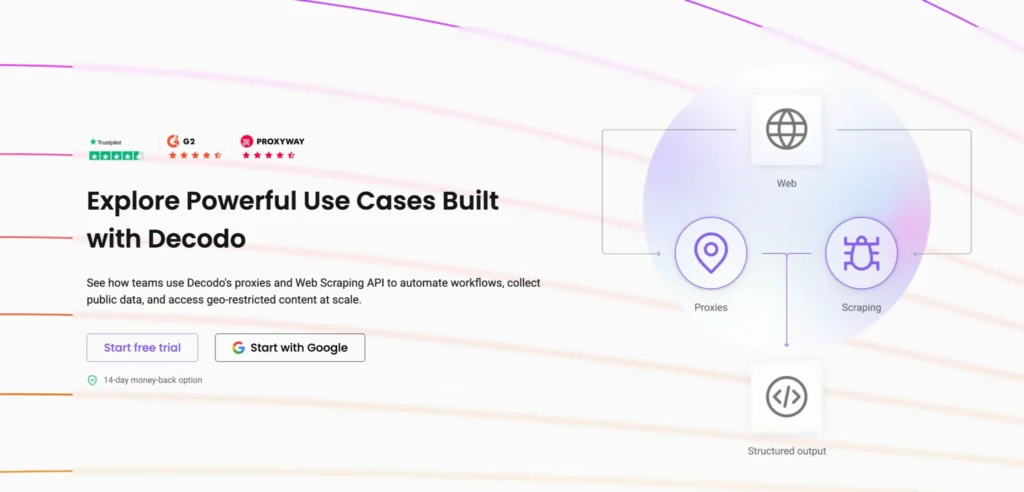
Decodo is best for users who need reliable proxies without jumping into enterprise-level cost or complexity. It is a strong fit for SEO agencies, affiliate marketers, eCommerce researchers, developers, ad verification teams, travel data projects, and small to mid-sized SaaS tools.
SEO teams can use Decodo for local rank tracking, SERP scraping, competitor checks, keyword monitoring, and search result comparison across different countries, states, cities, and ZIP codes. This is one of the clearest use cases because Google results can change heavily by location.
Affiliate marketers can use Decodo to verify advertiser landing pages, track geo redirects, check coupon visibility, monitor competitor funnels, and see how offers appear from different countries. This is useful for campaigns where traffic location affects commission flow, landing page experience, or offer availability.
ECommerce teams can use residential proxies and Site Unblocker for product page monitoring, stock checks, review scraping, marketplace tracking, and pricing intelligence. Datacenter proxies are better for easier targets, while Site Unblocker is better when the site uses stronger bot protection.
Developers and automation teams get value from Decodo because it supports common workflows. You can connect proxies to Python scripts, browser automation tools, no-code scrapers, proxy managers, and custom data pipelines without a long setup process.
Decodo Pros and Cons
Pros:
• Strong 115M+ residential IP pool across 195+ locations
• 125M+ total proxy IPs across the platform
• Good balance between pricing, usability, and technical depth
• Residential, datacenter, ISP, mobile, and Site Unblocker products
• HTTP(S) and SOCKS5 support across major proxy types
• Strong geo targeting, including country, state, city, ZIP code, and ASN options
• Beginner-friendly dashboard compared with enterprise-heavy providers
• Useful for SEO, affiliate marketing, eCommerce, ad verification, and automation
Cons:
• Not the cheapest provider for very small users
• Bright Data and Oxylabs offer deeper enterprise infrastructure
• Site Unblocker can become expensive for heavy usage
• Advanced scraping still requires proper setup and ethical request behavior
• Some pricing pages can feel confusing because products use different billing models
• Smaller users may not need the full product stack
Final Verdict: Is Decodo(Smartproxy) Worth It?
Smartproxy, now Decodo, is worth it if you want a proxy provider that feels powerful without being overly complicated. It is one of the best options for users who have moved beyond cheap, unreliable proxies but are not ready for a full enterprise data platform.
The biggest reason to choose Decodo is balance. Residential proxies are strong enough for SEO, affiliate research, price monitoring, and ad verification. Datacenter proxies are fast and affordable for easier scraping targets. ISP proxies are useful when long sessions and stable identity matter. Mobile proxies help with carrier-based testing. Site Unblocker gives you an advanced option when normal proxy rotation does not work.
It is not the perfect choice for every buyer. If your only goal is the lowest possible price, IPRoyal, Webshare, or PacketStream may look better. If you need enterprise-grade datasets, massive managed scraping operations, or custom data delivery, Bright Data or Oxylabs may be stronger. But for most practical scraping, SEO, affiliate, and business intelligence workflows, Decodo is one of the safest middle-ground choices.
The best way to use Decodo is to match the product to the task. Start with residential proxies when trust and location accuracy matter. Use datacenter proxies for speed and cheaper crawling. Use ISP proxies for stable sessions. Use mobile proxies for mobile-specific checks. Use Site Unblocker only when the target website is difficult enough to justify the extra cost.
Overall, Smartproxy remains highly relevant under the Decodo brand. It is clean, capable, scalable, and easier to use than many premium competitors. For serious users who want reliable public web data access without enterprise friction, it is easy to recommend.