
NetNut is built for users who need more than a cheap proxy list. It is aimed at businesses, SEO platforms, affiliate marketers, eCommerce intelligence teams, ad verification tools, cybersecurity researchers, AI data teams, and developers who collect public web data regularly. If your work depends on stable access, accurate geo targeting, and fewer failed requests, NetNut is a serious provider to consider.
The quick verdict is clear: NetNut is strongest for users who need scalable residential and ISP-style proxy infrastructure with strong performance and business-focused support.
It may not have the biggest public residential pool compared with Bright Data, Oxylabs, or Decodo, but its network is large enough for many real scraping operations. NetNut currently lists 85M+ rotating residential IPs across 195 countries, 1M+ static residential IPs, 5M+ mobile IPs, and 150K+ datacenter IPs.
That mix makes NetNut useful for several practical jobs. SEO teams can check local rankings and SERP layouts across countries or cities. Affiliate marketers can verify geo redirects, advertiser landing pages, coupon pages, and offer availability. eCommerce teams can monitor prices, stock status, delivery messages, reviews, and marketplace listings. AI and BI teams can collect public data for research, enrichment, and training pipelines.
NetNut is not always the best fit for a tiny scraping experiment. If you only need a few proxies for light browsing or simple testing, cheaper providers may feel easier. But for teams that need stable access to public web data, NetNut’s value comes from its proxy mix, one-hop connectivity positioning, unlimited concurrency on rotating residential proxies, and its stronger focus on business use cases.
NetNut Core Infrastructure: Proxy Pool, Locations, and Network Performance
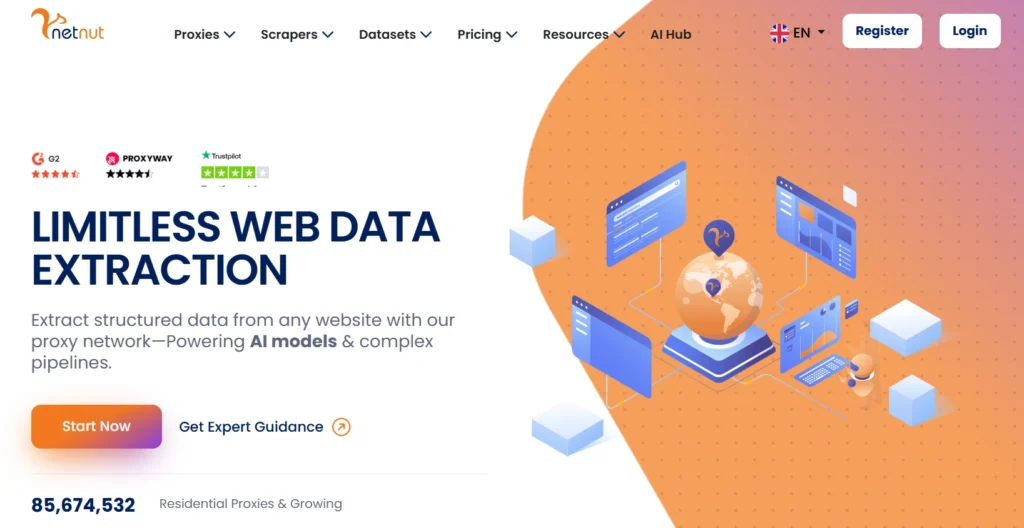
NetNut’s infrastructure is centered around residential proxies, but the broader product stack includes rotating residential, static residential, mobile, datacenter, and Website Unblocker solutions. This matters because different scraping jobs need different proxy behavior. A price monitoring project may need rotating residential IPs. A long account-based workflow may need static residential IPs. A mobile ad test may require mobile carrier IPs. A fast crawler may be better served by datacenter proxies.
The rotating residential network is the main product most users will look at first. NetNut lists 85M+ residential IPs across 195 countries, with city and state targeting, unlimited concurrency, and support for HTTP, HTTPS, and SOCKS5. That is a strong setup for high-volume public data collection, especially when your scraper needs to rotate IPs across many requests without hitting concurrency limits.
Residential proxies matter because they route traffic through real residential IP addresses instead of obvious server ranges. For websites that apply IP reputation checks, residential traffic often has a better trust profile than datacenter traffic. This is why residential proxies are commonly used for SERP scraping, product page monitoring, travel fare tracking, review collection, ad verification, social listening, and localized market research.
The static residential product gives NetNut another useful angle. NetNut lists 1M+ static IPs with 24/7 IP availability. These are better for workflows where continuity matters. For example, if you need to keep the same IP for account testing, marketplace research, cart flows, localized checkout checks, or repeated monitoring from one stable identity, static residential proxies can be more practical than constant rotation.
NetNut’s datacenter proxies are built for speed and scale. The provider lists 150K+ datacenter IPs across 200+ countries, static and rotating options, and a 99.99% uptime claim. Datacenter proxies are not as stealthy as residential IPs, but they are useful for fast crawling, uptime monitoring, QA testing, public database checks, competitive research, and less protected websites where speed matters more than residential trust.
Mobile proxies add another layer. NetNut lists 5M+ mobile IPs across 3G, 4G, 5G, and LTE networks. These are useful for mobile ad verification, mobile SERP checks, app testing, social media workflows, and any project where the website behaves differently for mobile carrier traffic.
NetNut Product Breakdown: Residential, Datacenter, and Website Unblocker
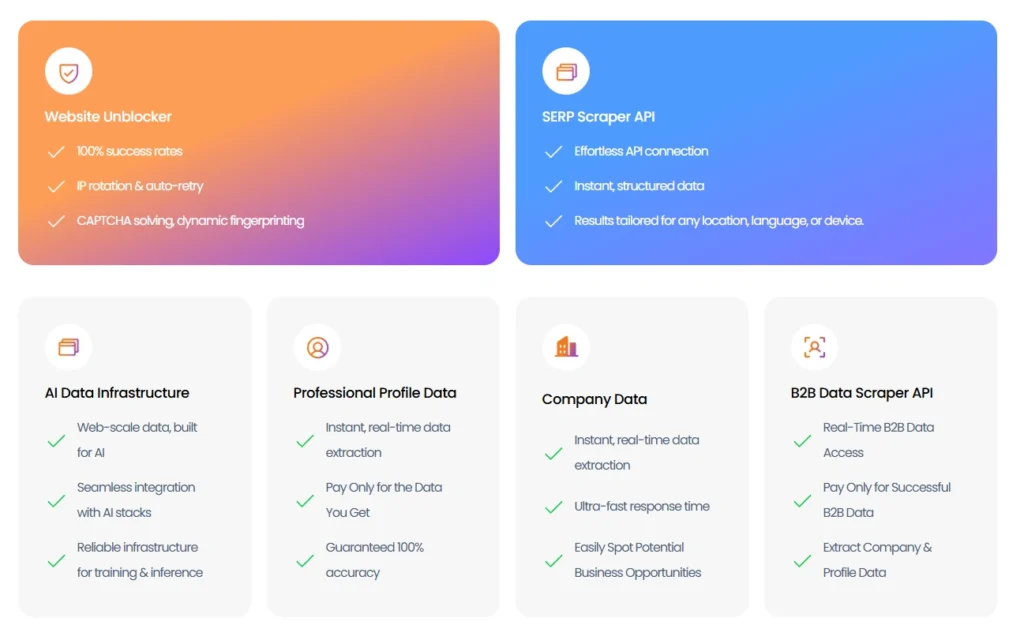
NetNut’s product lineup is best understood by matching each proxy type to a real task. Residential proxies are for trust and geo reach. Datacenter proxies are for speed and scale. Website Unblocker is the advanced layer for difficult sites where normal proxy rotation is not enough.
NetNut Rotating Residential Proxies
NetNut’s rotating residential proxies are the core product for most scraping and data collection use cases. With 85M+ residential IPs across 195 countries, this product is built for businesses that need broad location coverage and high request volume.
The main appeal is flexibility. You can use rotating IPs when scraping many public pages, checking search results, collecting marketplace data, monitoring prices, or verifying ads across different regions. Rotation helps reduce repeated requests from the same IP, which can lower the risk of blocks when paired with proper request pacing and clean scraper behavior.
Unlimited concurrency is one of the more important technical points. Some proxy providers limit how many simultaneous sessions you can run, which becomes a bottleneck for larger crawlers. NetNut’s rotating residential proxies are positioned for scale, so teams can run parallel scraping jobs without waiting on proxy capacity.
The HTTP, HTTPS, and SOCKS5 support also makes integration easier. Developers can connect NetNut to Python scripts, browser automation tools, data extraction platforms, anti-detect browsers, Scrapy, Selenium, Puppeteer, Playwright, or custom internal systems.
NetNut Datacenter Proxies
NetNut’s datacenter proxies are designed for users who need fast, stable, and scalable IP infrastructure. The company lists 150K+ global datacenter IPs across 200+ countries, along with static and rotating IP options and 99.99% uptime.
Datacenter proxies work best when the target website is not heavily protected or when speed is the main priority. They are useful for public site crawling, website change monitoring, QA checks, market research, brand monitoring, and large volume collection from easier targets.
The tradeoff is detection risk. Datacenter IPs come from server infrastructure, so some websites can identify and challenge them faster than residential traffic. For protected eCommerce sites, travel platforms, search engines, or social platforms, residential proxies or Website Unblocker will usually be safer.
NetNut Website Unblocker as the Next-Gen Proxy Layer
NetNut does not currently use the exact product name “Next-Gen Residential Proxies.” The closest equivalent is Website Unblocker, which is built for tougher websites that use CAPTCHAs, cloud protection, browser checks, and anti-bot systems.
A raw proxy only changes the IP behind your request. Website Unblocker does more. NetNut describes it as a tool that uses IP rotation, auto retry, CAPTCHA solving, and dynamic fingerprinting to imitate real users and access blocked pages.
This is important because many modern websites do not block traffic only by IP address. They check headers, cookies, browser fingerprints, JavaScript behavior, session consistency, TLS signals, and request timing. A normal residential proxy may still fail if the scraper looks unnatural. Website Unblocker helps reduce that engineering burden by handling more of the access layer.
For eCommerce scraping, SERP extraction, travel aggregation, marketplace monitoring, product intelligence, and AI data collection, this can be useful when standard proxy rotation starts producing blocks or incomplete pages.
NetNut Proxy Features and Technical Specs
| Product | Best For | Network and Coverage | Session Control | Protocols and Technical Specs | Practical Use Cases |
|---|---|---|---|---|---|
| Rotating Residential Proxies | Web scraping, SEO tracking, ad verification, price monitoring | 85M+ residential IPs across 195 countries | Rotating IPs with unlimited concurrency | HTTP, HTTPS, SOCKS5, city and state targeting | SERP checks, product scraping, travel fare tracking, affiliate landing page verification |
| Static Residential Proxies | Stable sessions and long-term identity | 1M+ static residential IPs | Persistent IP availability | 24/7 IP availability, one-hop connectivity positioning | Account testing, marketplace workflows, checkout monitoring, long-session scraping |
| Datacenter Proxies | Fast crawling and lower-cost scale | 150K+ datacenter IPs across 200+ countries | Static and rotating options | 99.99% uptime claim, high-speed IP infrastructure | QA testing, public site crawling, brand monitoring, website change tracking |
| Mobile Proxies | Mobile-first testing and carrier-based access | 5M+ mobile IPs on 3G, 4G, 5G, and LTE networks | Mobile IP rotation | Real carrier traffic, high success rate positioning | Mobile ads, app testing, mobile SERPs, social media workflows |
| Website Unblocker | Harder websites with anti-bot systems | Uses NetNut’s proxy infrastructure | Auto rotation and retries | CAPTCHA solving, dynamic fingerprinting, anti-bot handling | Protected eCommerce pages, SERPs, travel platforms, AI data pipelines |
The main takeaway is that NetNut is not just a residential proxy provider anymore. Its strongest value is the combination of rotating residential proxies, static residential IPs, mobile proxies, datacenter proxies, and Website Unblocker. That gives users enough flexibility to choose the right infrastructure for each job instead of forcing every task through one proxy type.
For businesses collecting public web data, that flexibility matters. A clean scraping setup is rarely about one feature. It is about pool size, targeting, session control, protocol support, uptime, and how well the provider handles difficult websites. On those points, NetNut is a strong proxy provider for serious users who need reliability more than the lowest possible entry price.
NetNut Pricing: Built for Serious Volume, Not Casual Testing
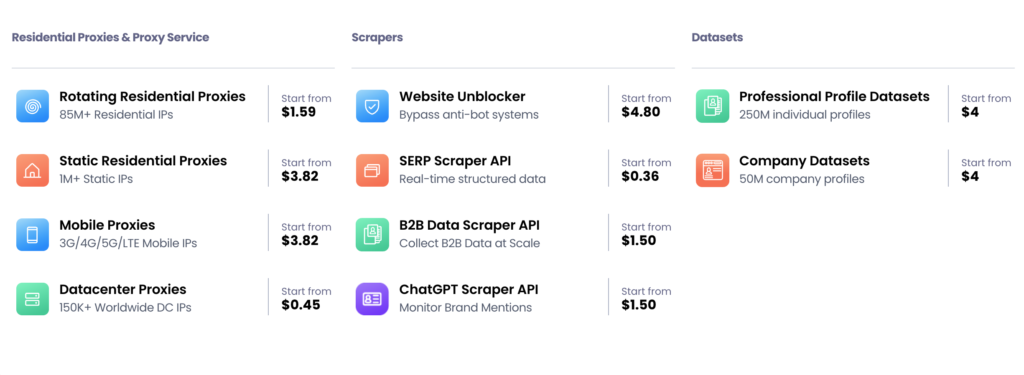
NetNut pricing is easier to understand when you separate the proxy types by job. Rotating residential proxies are priced by bandwidth, static residential proxies are also bandwidth based, mobile proxies carry a higher cost because they use mobile carrier networks, and datacenter proxies are the cheapest option for high-speed scraping. Website Unblocker is different because it is not just a raw proxy product. It is a managed access layer for harder websites.
For rotating residential proxies, NetNut’s monthly pricing starts at $99 for 28GB, which works out to $3.53 per GB. The next plan includes 72GB for $249 at $3.45 per GB. The 150GB plan is $499 at $3.32 per GB, while higher-volume plans reduce the rate further. The 350GB plan costs $999 at $2.85 per GB, the 800GB plan costs $1,999 at $2.49 per GB, and the 2TB plan costs $3,750 at $1.87 per GB.
That pricing tells you exactly who NetNut is built for. It is not the cheapest residential proxy option for a tiny one-off scraping job. But it becomes more attractive when you are running ongoing data collection and need predictable capacity, unlimited concurrency, and support for business workflows. A small affiliate marketer checking ten URLs per month may not need this much bandwidth. A price comparison platform, SEO rank tracker, ad verification vendor, or market intelligence tool will look at NetNut differently because failed requests and unstable access can cost more than the proxy plan itself.
Static residential proxies start at $99 per month for 7GB, or $14.4 per GB. The 20GB plan costs $250 at $12.5 per GB, the 50GB plan costs $499 at $9.98 per GB, and larger plans reduce the rate down to $4.5 per GB on the 1TB monthly plan. These are more expensive than rotating residential proxies, but they solve a different problem. Static residential proxies are useful when you need the same IP to stay stable for account workflows, localized checkout checks, marketplace research, long sessions, or repeated testing from the same identity.
Mobile proxies start at $99 per month for 13GB, which comes to $7.6 per GB. The 34GB plan is $250 at $7.35 per GB, and the 72GB plan is $499 at $6.93 per GB. The pricing drops on larger plans, especially annual billing. Mobile proxies are costly compared with datacenter proxies, but they are useful when you need traffic that looks like it comes from real mobile carriers. That matters for mobile ad verification, social media management, app testing, mobile SERP checks, and mobile-only landing page research.
Datacenter proxies are the most affordable NetNut product. The starter plan is $100 per month for 100GB at $1 per GB. The 250GB plan costs $185 at $0.74 per GB, and larger plans bring the price lower. Datacenter proxies make the most sense for fast crawling, QA testing, uptime checks, public database monitoring, and websites that do not heavily block server-based IPs.
| NetNut Product | Starting Monthly Plan | Pricing Model | Best Use Case |
|---|---|---|---|
| Rotating Residential Proxies | $99 for 28GB | Bandwidth based | SERP scraping, eCommerce monitoring, ad verification, market research |
| Static Residential Proxies | $99 for 7GB | Bandwidth based | Long sessions, account workflows, localized checkout testing |
| Mobile Proxies | $99 for 13GB | Bandwidth based | Mobile ads, app testing, social media workflows, mobile SERPs |
| Datacenter Proxies | $100 for 100GB | Bandwidth based | Fast crawling, QA checks, public data extraction, automation |
| Website Unblocker | Sales-led or account-based | Managed unblocking layer | CAPTCHAs, anti-bot systems, protected public websites |
NetNut vs Competitors: Where It Wins and Where It Feels Limited
NetNut competes most directly with Bright Data, Oxylabs, Decodo, SOAX, and IPRoyal. It is not the biggest proxy provider by public residential pool size, but it has a clear advantage for users who want business-focused residential, ISP, mobile, and datacenter options without dealing with an overly broad data platform.
Against Bright Data, NetNut feels more focused. Bright Data has the larger ecosystem, including proxies, Web Unlocker, scraping APIs, datasets, browser products, and enterprise data services. It is powerful, but it can feel heavy for proxy-focused teams. NetNut is better when you want strong proxy infrastructure and direct business support without needing a full public data platform.
Compared with Oxylabs, NetNut sits slightly below the highest enterprise tier in perceived product depth, but it remains a strong option for high-volume scraping teams. Oxylabs has a larger residential pool, strong scraping APIs, and a very mature Web Unblocker product. NetNut competes well with rotating residential proxies, static residential IPs, and mobile proxies, especially when the buyer values unlimited concurrency and one-hop connectivity positioning.
Decodo, formerly Smartproxy, is more beginner-friendly and often easier for small teams to start with. It has a polished dashboard, strong residential coverage, and more approachable pricing for smaller users. NetNut is better suited for teams that already know their scraping volume and need business-grade proxy capacity instead of a lightweight starter plan.
IPRoyal is the stronger budget pick. It offers cheaper residential traffic, non-expiring bandwidth, and a simple buying experience. NetNut is better for larger businesses that need higher volume plans, dedicated support, static residential options, and a more enterprise-facing setup.
SOAX competes well on targeting, usability, and flexible proxy access. It can be a better fit for teams that care deeply about granular geo control and a cleaner dashboard. NetNut feels stronger when the project is volume-heavy and needs residential, static residential, mobile, datacenter, and unblocker support under one vendor.
Who Should Use NetNut?
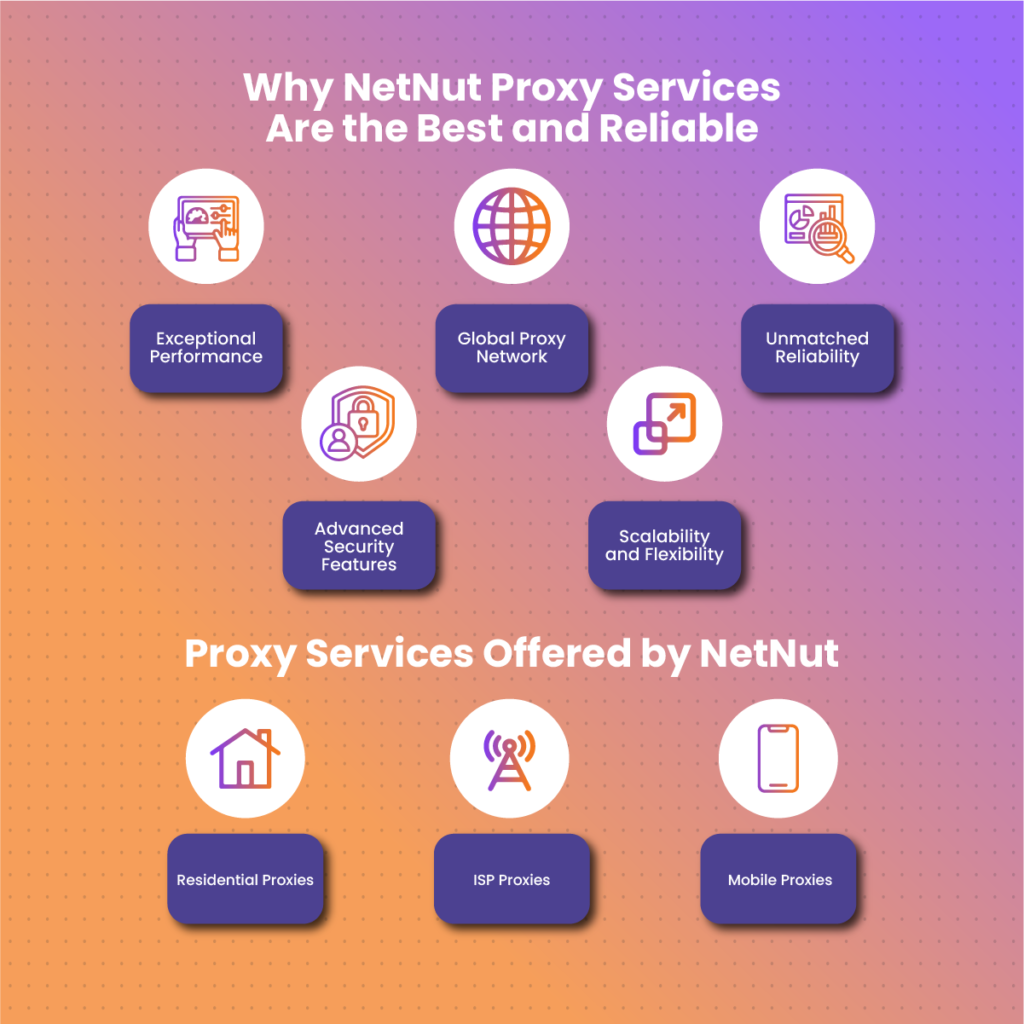
NetNut is best for teams that collect public web data regularly. It makes the most sense when scraping is tied to revenue, product research, reporting, monitoring, or client deliverables.
SEO teams can use NetNut for local SERP tracking, keyword monitoring, competitor analysis, and search result checks across different regions. Affiliate marketers can use it to verify geo-targeted landing pages, advertiser redirects, coupon visibility, offer pages, and competitor funnels. Ecommerce teams can use rotating residential proxies for price monitoring, stock tracking, marketplace checks, review scraping, and product intelligence.
Static residential proxies are a strong fit for account-based workflows. If a project needs the same IP for a long session, static IPs are usually safer than constantly rotating residential proxies. Mobile proxies are better for social media, mobile app testing, and mobile-first ad verification. Datacenter proxies are the better value when the target website is easy enough and speed matters more than residential trust.
NetNut is less ideal for very small users who want a few dollars of proxy traffic for casual testing. It is also not the best match for buyers who want ready-made datasets or a full scraping IDE. For those users, Bright Data or Oxylabs may feel more complete. But for teams that need reliable proxy capacity and do not want to jump between five different vendors, NetNut is a serious option.
NetNut Pros and Cons
Pros:
• Strong rotating residential network with 85M+ IPs across 195 countries
• Unlimited concurrency on rotating residential proxies
• Static residential proxies for stable, long-session workflows
• Mobile proxies for carrier-based testing and mobile ad verification
• Datacenter proxies start at a practical $1 per GB entry point
• Website Unblocker adds an advanced layer for difficult targets
• Supports HTTP, HTTPS, and SOCKS5 on major proxy products
• Strong fit for SEO, eCommerce, ad verification, AI data collection, and market research
Cons:
• Residential pool is smaller than Bright Data, Oxylabs, and Decodo
• Entry pricing is not ideal for casual users or tiny projects
• Static residential proxies are expensive at smaller bandwidth levels
• Website Unblocker pricing is less transparent than standard proxy plans
• Dashboard and onboarding may feel more business-focused than beginner-friendly
• Users who need datasets or scraping APIs may prefer Bright Data or Oxylabs
Final Verdict: Is NetNut Worth It?
NetNut is worth it if your project needs stable proxy infrastructure for ongoing public data collection. It is especially strong for teams that need rotating residential proxies, static residential IPs, mobile proxies, datacenter proxies, and an unblocker product under one provider.
The biggest reason to choose NetNut is not that it has the largest proxy pool. It does not. Bright Data, Oxylabs, and Decodo publish larger residential numbers. NetNut’s value comes from business-focused infrastructure, unlimited concurrency on rotating residential proxies, strong static residential options, mobile IP coverage, and a pricing structure that makes sense once your usage reaches serious volume.
For smaller buyers, IPRoyal, Webshare, or Decodo may be easier to start with. For enterprise buyers that need datasets, managed scraping APIs, and a broader data collection ecosystem, Bright Data or Oxylabs may be stronger. But for companies that need dependable proxies for SEO monitoring, eCommerce data, ad verification, travel aggregation, social media workflows, and market intelligence, NetNut is a strong middle-to-premium option.
The best way to use NetNut is to match the product to the task. Use rotating residential proxies for large-scale scraping and location-sensitive public data. Use static residential proxies when identity stability matters. Use mobile proxies for carrier-based testing. Use datacenter proxies for faster, cheaper crawling on easier targets. Use Website Unblocker when normal proxies cannot reliably handle CAPTCHAs, fingerprint checks, and anti-bot systems.
Overall, NetNut is a serious proxy provider for serious users. It may not be the cheapest or the largest, but it offers enough scale, product variety, and business-grade reliability to deserve a place in any shortlist for high-volume proxy infrastructure.