
Bright Data and NetNut are two serious names in the residential proxy market. Both are built for users who need real residential IPs for web scraping, SEO monitoring, ad verification, ecommerce research, price tracking, market research, and data collection.
At first, both tools look similar. They both offer rotating residential proxies, global IP coverage, sticky sessions, scraping support, and business level infrastructure. But when you compare them closely, they are built for slightly different users.
Bright Data is a larger and more complete web data platform. It gives you access to one of the biggest residential proxy networks in the market, deep geo targeting, strong proxy controls, Web Unlocker, Browser API, Web Scraper API, SERP API, and ready made datasets. It is powerful, but it can feel advanced if you are new to proxies.
NetNut is more focused on residential proxy performance, direct ISP connectivity, and simpler residential proxy plans. It is not as broad as Bright Data, but it has a strong residential proxy network, clear pricing, fast connections, city and state targeting, API access, IP whitelisting, and dedicated account manager support on all listed residential plans.
So, which one is better?
Bright Data is better if you want the biggest residential proxy pool, advanced targeting, flexible proxy controls, and a full data collection platform.
NetNut is better if you want a simpler residential proxy provider with clear pricing, fast ISP routed architecture, and strong value for high volume residential proxy usage.
Now let’s compare both in detail.
Quick Comparison Table: Bright Data vs NetNut
| Feature | Bright Data | NetNut |
|---|---|---|
| Best For | Enterprise scraping, advanced residential proxy targeting, large data operations | Residential proxy users, scraping teams, SEO teams, price monitoring, ad verification |
| Residential Proxy Pool | 400M plus monthly residential IPs | 85M plus residential IPs |
| Country Coverage | 195 countries | 195 plus countries |
| Proxy Type Focus | Residential, datacenter, ISP, mobile, Web Unlocker, Browser API, Web Scraper API, datasets | Residential, rotating residential, static residential, mobile, datacenter, ISP, Website Unblocker, SERP Scraper API |
| Residential Pricing | Pay as you go from $8 per GB, currently shown at $4 per GB with promo | Starts at $99 per month for 28 GB at $3.53 per GB |
| Entry Cost | Lower entry if using pay as you go | Higher starting plan at $99 per month |
| High Volume Pricing | $1,999 per month for 798 GB at $2.50 per GB with current promo | $3,750 per month for 2 TB at $1.87 per GB monthly, or $3,180 per month annually at $1.59 per GB |
| Geo Targeting | Country, state, city, ZIP code, ASN, and carrier options depending on setup | City and state selection included on residential plans |
| Sessions | Sticky and rotating sessions | Rotating residential proxies with support for large scale scraping |
| Concurrent Connections | Unlimited concurrent sessions listed by Bright Data | Unlimited connections for all residential packages |
| Ease of Use | Powerful but more complex | Easier and more focused |
| Best for Beginners | Good with managed tools, but raw setup can feel advanced | Easier for users focused mainly on residential proxies |
| Best for Advanced Users | Better for advanced users and enterprise teams | Strong for advanced residential proxy users, but less broad as a data platform |
| Overall Strength | Larger network and deeper platform | Cleaner residential proxy value and simpler plans |
Bright Data Overview
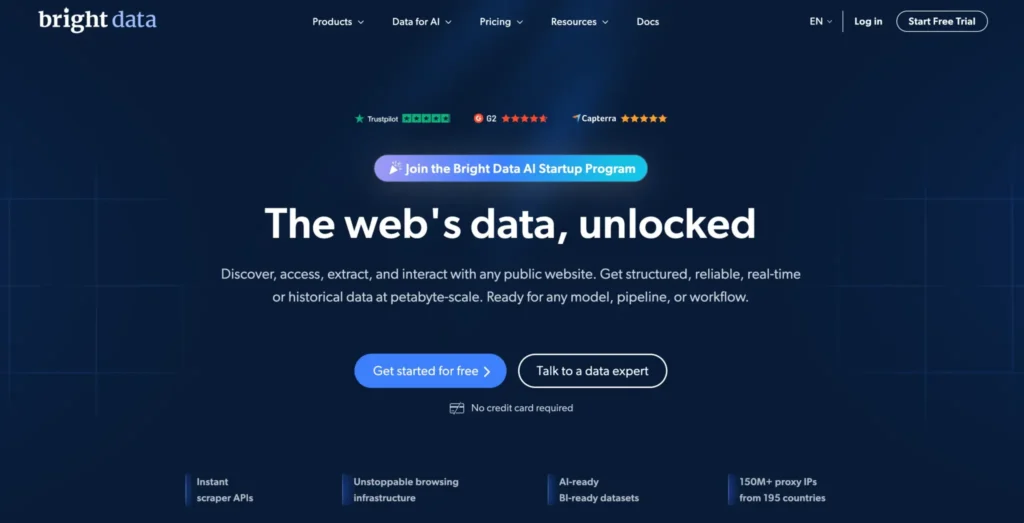
Bright Data is one of the biggest proxy and web data platforms in the world. It is not only a residential proxy provider. It also offers datacenter proxies, ISP proxies, mobile proxies, Web Unlocker, Browser API, Web Scraper API, SERP API, ready made datasets, and other data collection tools.
The biggest strength of Bright Data is scale. Its residential proxy network is huge, and it gives users very deep control over location targeting, sessions, rotation, and traffic rules. This makes it a strong choice for companies that collect large amounts of public web data from many regions.
Bright Data is especially useful for large ecommerce monitoring, search engine result tracking, ad verification, travel fare tracking, brand protection, market research, and AI data collection.
The platform is powerful, but it is not the simplest option. Beginners may need time to understand zones, proxy types, targeting rules, API options, and billing models. For technical users, this control is a big advantage. For casual users, it may feel like too much.
Bright Data Key Features
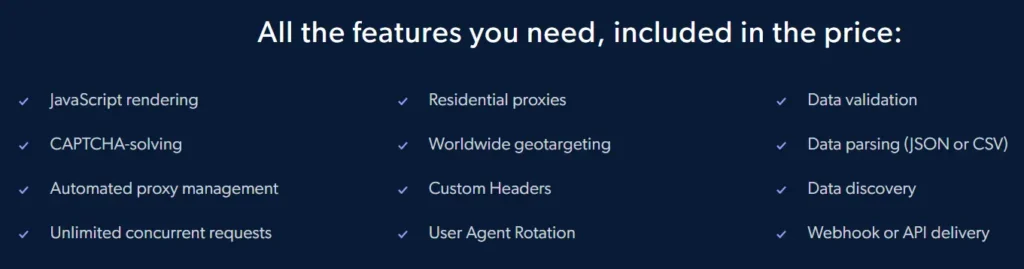
Bright Data’s main feature is its large residential proxy pool. It gives users access to 400M plus monthly residential IPs from 195 countries. This is much larger than most residential proxy networks in the market.
The platform also offers very detailed geo targeting. Users can target by country, state, city, ZIP code, ASN, and carrier depending on the product and setup. This is useful for checking local search results, regional ecommerce prices, local ads, travel fares, and geo restricted content.
Bright Data supports sticky and rotating sessions. Sticky sessions help when you need to keep the same IP for a short period. Rotating sessions are better when you want a new IP for each request or each task.
Another major feature is Web Unlocker. Instead of manually handling proxy rotation, headers, retries, blocks, and CAPTCHA related problems, users can send requests through Bright Data’s managed unlocking layer.
Bright Data also has Browser API, which helps with JavaScript heavy websites. If a website needs a real browser to load content properly, Browser API can be more useful than basic proxy requests.
The company also offers Web Scraper API and ready made datasets. This is helpful if you do not want to build every scraper yourself.
Bright Data Pros
Bright Data has one of the largest residential proxy networks available. This gives it a clear advantage for large scale scraping, heavy rotation, and advanced location based tasks.
It also has excellent targeting. Country, state, city, ZIP code, ASN, and carrier level targeting make it useful for serious local data collection.
The platform is also strong for difficult scraping projects. Web Unlocker and Browser API can save time when target websites have stronger anti bot systems.
Bright Data is a good choice for enterprise teams because it offers more than proxies. You can use proxy networks, scraping APIs, browser tools, SERP tools, and datasets from one platform.
It also offers strong control over sessions, rotation, traffic, and usage. This is helpful for technical teams that want to build custom workflows.
Bright Data Cons
Bright Data can feel complex for beginners. There are many products, settings, and pricing models. A new user may not know whether to choose residential proxies, Web Unlocker, Browser API, or Web Scraper API.
Pricing can also be confusing because each product has a different billing model. Residential proxies are billed by GB, while scraping APIs and unlocking tools may use different pricing structures.
Bright Data may also be more than what a small user needs. If your only requirement is a simple residential proxy plan, NetNut may feel easier.
Some use cases may require compliance checks. This is good from a trust and policy point of view, but it can add extra steps before you start.
Bright Data Pricing
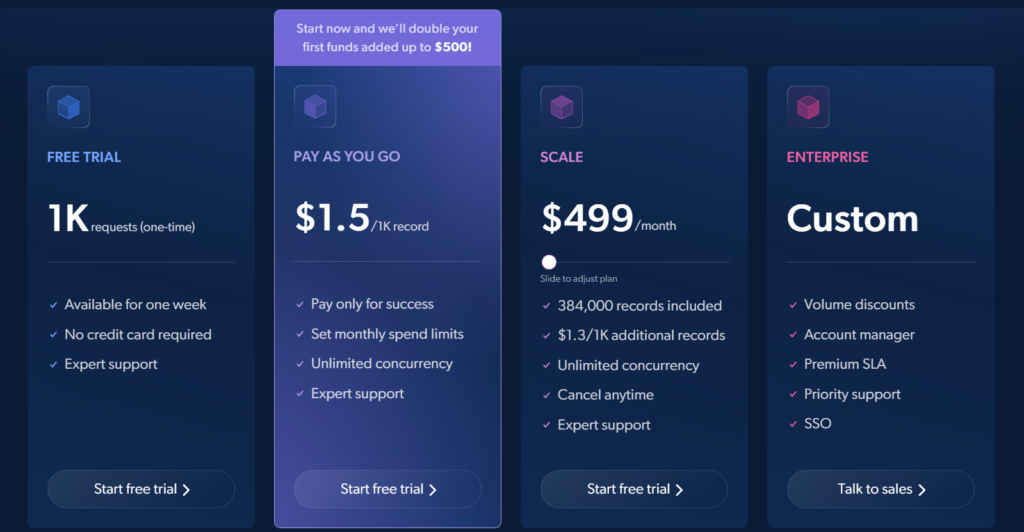
Bright Data’s residential proxy pricing is based on bandwidth. The current public pricing page shows a 50 percent promotional offer on residential proxies, but the normal price is also shown.
| Bright Data Residential Plan | Included Traffic | Current Promo Price | Standard Listed Price | Monthly Cost |
|---|---|---|---|---|
| Pay As You Go | No fixed monthly traffic | $4.00 per GB | $8.00 per GB | No commitment |
| Growth Plan | 141 GB | $3.50 per GB | $7.00 per GB | $499 per month |
| Business Plan | 332 GB | $3.00 per GB | $6.00 per GB | $999 per month |
| Scale Plan | 798 GB | $2.50 per GB | $5.00 per GB | $1,999 per month |
| Custom Plan | More than 1 TB | Custom | Custom | Contact sales |
The biggest advantage is that Bright Data has a pay as you go option. This makes it easier to test without choosing a large monthly plan.
At the same time, the best per GB pricing comes with larger monthly plans. If you are doing high volume scraping, the larger plans may make more sense.
The promo pricing is attractive, but you should always check the checkout page before buying because proxy pricing and offers can change.
Bright Data Best For
Bright Data is best for enterprise teams, advanced developers, ecommerce data companies, SEO platforms, ad verification companies, travel data teams, AI data companies, and market research firms.
It is also best for users who want more than residential proxies. If you need Web Unlocker, Browser API, SERP API, datasets, and advanced scraping infrastructure, Bright Data is a better fit than NetNut.
Bright Data is not the simplest option for beginners, but it is one of the strongest options for serious proxy and web data projects.
NetNut Overview
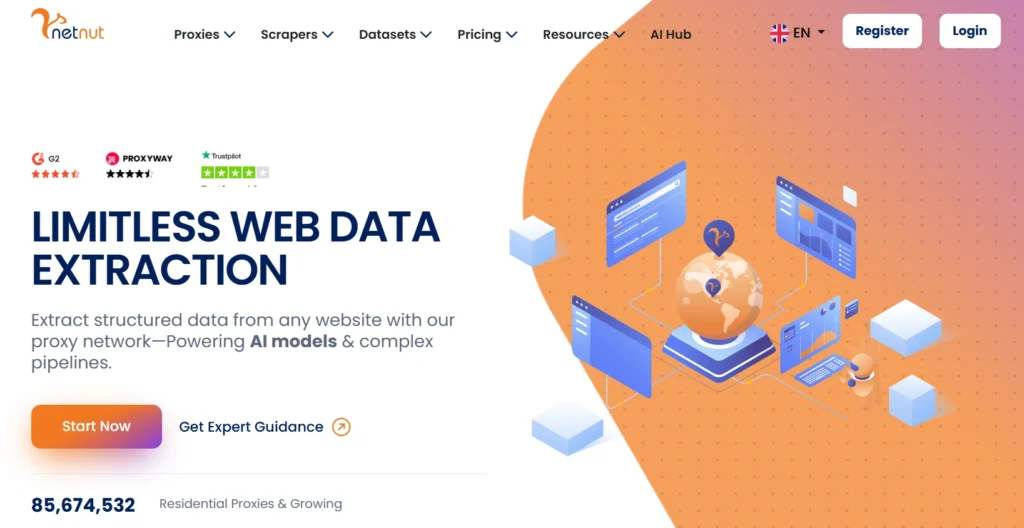
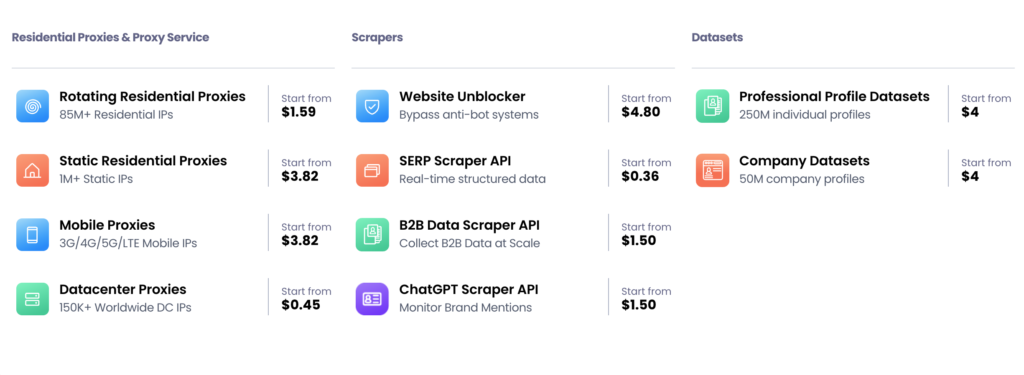
NetNut is a premium proxy provider known for residential proxies, rotating residential proxies, static residential proxies, mobile proxies, datacenter proxies, ISP proxies, Website Unblocker, and SERP Scraper API.
Its main strength is residential proxy performance. NetNut promotes a direct ISP based architecture, where traffic is routed through ISP networks instead of relying only on end user peer to peer routing. This is one of the reasons many users choose NetNut for speed, stability, and large scale scraping.
NetNut offers 85M plus residential IPs across 195 plus countries. That is smaller than Bright Data’s listed pool, but it is still a large residential network.
The platform also has clearer pricing than Bright Data. Residential plans are easy to understand. You choose the traffic package, see the price per GB, and know your monthly cost.
NetNut is especially strong for users who mainly want residential proxies and do not need a huge all in one data platform.
NetNut Key Features
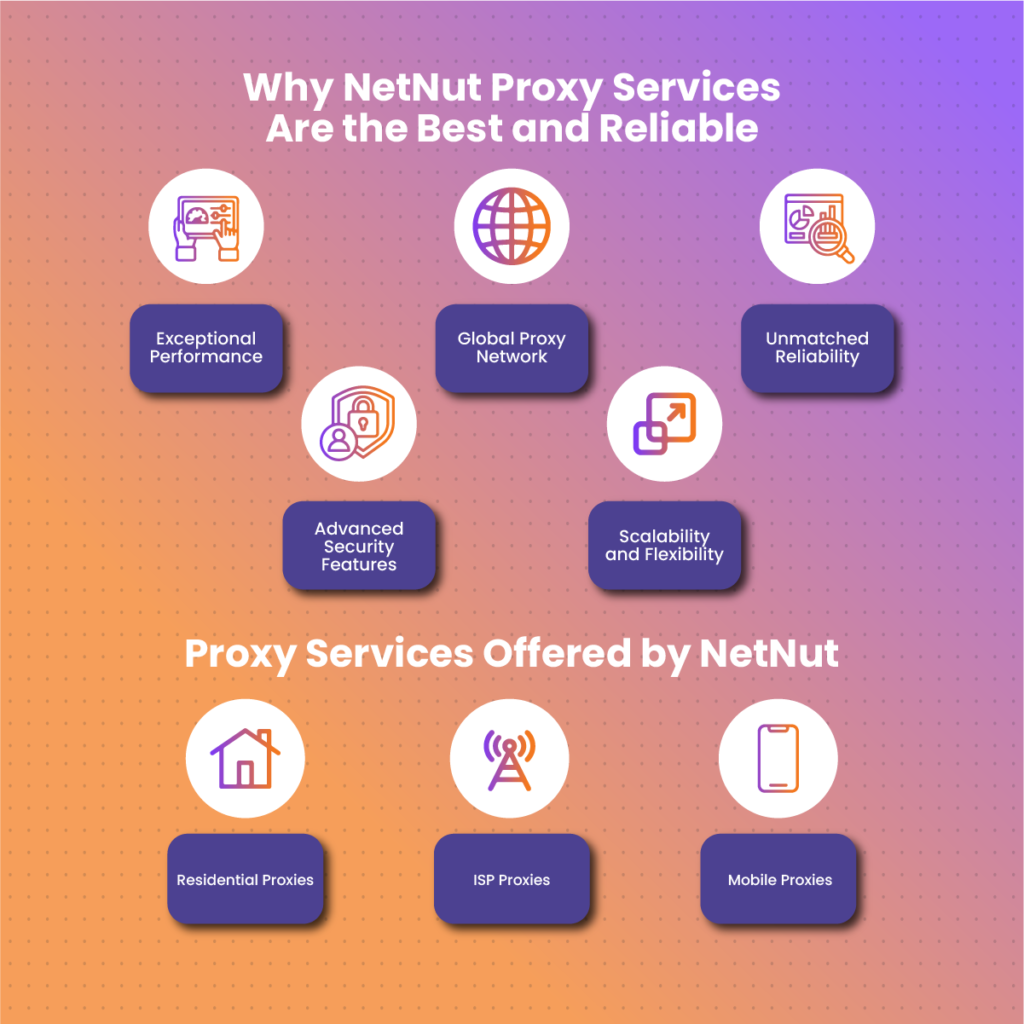
NetNut’s residential proxy network includes 85M plus residential IPs across 195 plus countries. This gives users wide coverage for global web scraping, SEO monitoring, ecommerce research, ad verification, and market research.
One of NetNut’s key selling points is speed. The platform promotes one hop connectivity and direct ISP routing. In simple terms, NetNut is designed to reduce the traffic bottlenecks that can happen when proxy traffic depends too much on end user devices.
NetNut residential plans include unlimited connections. This is useful for teams that need to run many scraping tasks at the same time.
The residential plans also include city and state selection, API access, IP whitelist, and dedicated account manager support. These are useful features for business users because they reduce setup friction.
NetNut also offers rotating residential proxies and static residential proxies. Rotating residential proxies are better for large scale scraping, while static residential proxies are better when you need a stable IP for longer sessions.
The company also offers Website Unblocker and SERP Scraper API. These tools are useful for users who want managed scraping support instead of handling every proxy detail manually.
NetNut Pros
NetNut is easier to understand than Bright Data if your main need is residential proxies. Its pricing table is clear, and the plans are based on traffic volume.
NetNut also offers strong value at higher volume. Its monthly residential plans go down to $1.87 per GB on the 2 TB plan, and annual billing lowers that further to $1.59 per GB.
Another benefit is unlimited connections on all residential packages. This is useful for users running multiple jobs at once.
NetNut’s ISP based architecture is also a strong point for speed and stability. For data collection tasks that need consistent performance, this can be a real advantage.
The platform also includes useful business features like API access, IP whitelist, city and state selection, and dedicated account manager support.
NetNut Cons
NetNut has a smaller residential proxy pool than Bright Data. Bright Data lists 400M plus monthly residential IPs, while NetNut lists 85M plus residential IPs.
NetNut also has a higher starting cost. The entry monthly residential plan is $99 for 28 GB. Bright Data has a pay as you go option, which can be easier for testing small projects.
NetNut is also not as broad as Bright Data. It offers proxy products and scraping tools, but Bright Data has a larger platform with more advanced products, datasets, browser tools, and data services.
If you need deep targeting like ZIP code, ASN, carrier level options, and advanced data platform tools, Bright Data may be stronger.
NetNut Pricing
NetNut’s residential proxy pricing is simple. The public pricing page shows monthly and annual options.
| NetNut Residential Plan | Included Traffic | Monthly Price | Monthly Price Per GB |
|---|---|---|---|
| Starter | 28 GB | $99 per month | $3.53 per GB |
| Advanced | 72 GB | $249 per month | $3.45 per GB |
| Production | 150 GB | $499 per month | $3.32 per GB |
| Semi Pro | 350 GB | $999 per month | $2.85 per GB |
| Professional | 800 GB | $1,999 per month | $2.49 per GB |
| Master | 2 TB | $3,750 per month | $1.87 per GB |
NetNut also offers annual billing, which lowers the monthly equivalent price.
| NetNut Annual Billing Plan | Included Traffic | Monthly Equivalent | Price Per GB |
|---|---|---|---|
| Starter | 28 GB | $84 per month | $3.00 per GB |
| Advanced | 72 GB | $210 per month | $2.93 per GB |
| Production | 150 GB | $423 per month | $2.82 per GB |
| Semi Pro | 350 GB | $850 per month | $2.43 per GB |
| Professional | 800 GB | $1,696 per month | $2.12 per GB |
| Master | 2 TB | $3,180 per month | $1.59 per GB |
NetNut becomes more attractive as your usage grows. For small tests, $99 may feel high. But for high volume residential proxy usage, the per GB pricing can be very competitive.
NetNut Best For
NetNut is best for users who want fast, stable residential proxies with simple pricing.
It is a strong fit for SEO tracking, ecommerce price monitoring, ad verification, review monitoring, market research, and web scraping teams that need reliable residential IPs.
It is also a good choice for users who care more about residential proxy performance than having a complete data platform.
If you want a proxy provider that is easier to understand than Bright Data and still powerful enough for business use, NetNut is a strong option.
Feature by Feature Comparison
Bright Data wins on network size. Its 400M plus monthly residential IP pool is much larger than NetNut’s 85M plus residential IP pool. This matters when you need huge rotation capacity, more location options, and more flexibility across different tasks.
NetNut wins on residential proxy simplicity. Its plans are easier to understand, and the platform is more focused. You choose a residential plan, get traffic, and start using it.
Bright Data wins on targeting depth. It offers country, state, city, ZIP code, ASN, and carrier targeting depending on the setup. This is useful for very specific local scraping and ad verification.
NetNut also offers city and state selection, which is enough for many SEO and ecommerce use cases. But Bright Data gives more advanced targeting options overall.
Bright Data wins on product range. It gives you residential proxies, datacenter proxies, ISP proxies, mobile proxies, Web Unlocker, Browser API, Web Scraper API, SERP API, and datasets.
NetNut also offers several products, including rotating residential proxies, static residential proxies, mobile proxies, datacenter proxies, ISP proxies, Website Unblocker, and SERP Scraper API. But Bright Data is still the broader platform.
NetNut wins on high volume residential pricing if you commit to large plans, especially annual billing. Its Master annual plan comes down to $1.59 per GB, which is lower than Bright Data’s current listed residential promo pricing for plans shown publicly.
Bright Data wins for flexible testing because it has pay as you go pricing. You do not need to start with a $99 monthly residential plan.
Pricing
Pricing is one of the most important parts of this comparison.
Bright Data has a lower entry barrier because of pay as you go pricing. If you only want to test residential proxies, you can start without committing to a large monthly plan.
NetNut has a higher starting monthly price. Its entry plan is $99 per month for 28 GB. That is not ideal if you only need a few GB.
But NetNut becomes very attractive at higher volume. Its monthly residential pricing goes down to $1.87 per GB on the 2 TB plan. With annual billing, it goes down to $1.59 per GB.
Bright Data’s current residential promo pricing starts at $4 per GB on pay as you go and goes down to $2.50 per GB on the 798 GB monthly plan. Bright Data also offers custom pricing for more than 1 TB, so large customers may get a different rate.
Here is the simple pricing verdict.
Choose Bright Data if you want flexible testing, pay as you go access, and no fixed monthly residential commitment.
Choose NetNut if you already know you need high volume residential proxy traffic and want lower per GB pricing on bigger plans.
Ease of Use
NetNut is easier to use if your main goal is residential proxies.
The dashboard, pricing, and product structure are more direct. You pick a plan, set up your proxy details, use API access or IP whitelist, and start working.
Bright Data is more advanced. It gives you many tools and settings, but that also means a bigger learning curve. You may need to understand proxy zones, permissions, compliance, targeting, session rules, APIs, and billing models.
For a beginner, NetNut feels easier.
For an advanced user, Bright Data gives more control.
Performance and Proxy Quality
Both providers are premium residential proxy networks, but they approach performance differently.
Bright Data focuses on massive scale, deep targeting, and a strong global infrastructure. Its large IP pool is useful when you need high rotation, many countries, and advanced geo coverage.
NetNut focuses on speed and stability through its ISP based architecture. The company promotes direct ISP routing and one hop connectivity, which can help reduce bottlenecks and improve consistency.
For easy and medium difficulty websites, both can perform well.
For difficult websites, the better option depends on the target. Some sites may work better with Bright Data because of its larger pool and advanced tools. Others may work better with NetNut because of its stable ISP based routing.
The safest approach is to test both with your actual target websites before buying a large plan.
Customer Support
Both providers offer business focused support.
Bright Data has strong documentation, dashboard support, enterprise assistance, compliance support, and technical resources. It is a good choice for companies that need help building larger data workflows.
NetNut includes a dedicated account manager on its listed residential plans. That is useful because even the entry plan includes business level support features. It also offers support channels and guidance for proxy setup.
For beginners, NetNut may feel more personal and easier to work with.
For enterprise teams, Bright Data may be stronger because it has a wider platform and more advanced support needs.
Refund Policy
NetNut publicly mentions a 7 day free trial for residential proxies. It also states that it generally does not offer refunds, but refund requests may be reviewed based on how much of the plan has been used.
Bright Data offers free trial options and account verification steps. Its residential proxy pricing page also mentions starting a free trial. Refund terms can depend on the product, usage, and account terms, so users should check the billing terms before buying.
For both providers, the safest move is simple: start with a trial or smaller plan, test your actual target websites, check success rates, then upgrade.
Which One is Better for Beginners?
NetNut is better for beginners who mainly need residential proxies.
It is easier to understand, the pricing is simple, and the plans clearly show traffic, monthly price, and per GB cost. If you are doing SEO tracking, ecommerce monitoring, ad checks, or market research, NetNut is easier to start with.
Bright Data can still work for beginners, especially if they use Web Unlocker or Web Scraper API instead of raw proxies. But if a beginner starts with raw residential proxies, Bright Data may feel more technical.
So the beginner recommendation is NetNut for residential proxies and Bright Data only if you are ready to use a more advanced platform.
Which One is Better for Advanced Users?
Bright Data is better for advanced users.
The reason is simple. It gives more control, more targeting options, more scraping tools, and a mReal World Use Cases
SEO Rank Tracking
SEO rank tracking needs accurate local results, stable access, and the ability to check search pages from many locations.
Bright Data is excellent for large SEO platforms because it has deep geo targeting and SERP related tools. If you need city, ZIP code, ASN, or large scale SERP data, Bright Data is the stronger option.
NetNut is also strong for SEO teams. Its city and state selection, residential IP pool, and stable connections make it useful for rank tracking and local SEO checks.
Best pick: Bright Data for large SEO software platforms. NetNut for SEO agencies and teams that want simpler residential proxy pricing.
Ecommerce Price Monitoring
Ecommerce price monitoring requires stable scraping across product pages, category pages, search pages, stock data, and regional pricing.
Bright Data is better for large ecommerce intelligence projects because it has residential proxies, Web Unlocker, Browser API, and scraping APIs.
NetNut is strong for price monitoring because its residential proxy network is built for speed and stability. It is also cost effective at higher bandwidth levels.
Best pick: Bright Data for complex ecommerce data pipelines. NetNut for high volume price monitoring where residential proxy cost matters.
Ad Verification
Ad verification needs accurate geo targeting and real user style access. You may need to check how ads appear in different cities, countries, networks, or devices.
Bright Data is better for advanced ad verification because of its large network and deeper targeting options.
NetNut is still a good choice for simpler ad verification tasks, especially when city and state level checks are enough.
Best pick: Bright Data for advanced global ad verification. NetNut for simpler regional ad checks.
Travel Fare Tracking
Travel fare tracking is difficult because airline, hotel, and booking websites often change prices based on location, demand, and user behavior.
Bright Data is strong here because Web Unlocker and Browser API can help with difficult travel websites.
NetNut can also work well because fast and stable residential proxies are useful for checking fares across regions.
Best pick: Bright Data for difficult travel websites. NetNut for high volume residential fare checks.
Market Research
Market research can include collecting product data, reviews, competitor prices, job listings, business listings, search results, and public trend data.
Bright Data is better if you want a complete data platform with APIs, datasets, and managed scraping options.
NetNut is better if you already have your own scraping setup and mainly need residential proxy access.
Best pick: Bright Data for enterprise market intelligence. NetNut for proxy first research teams.
Final Verdict: Is Bright Data Better Than NetNut?
Bright Data is better than NetNut if you want the largest residential proxy pool, deeper targeting, more scraping tools, and a complete web data platform.
NetNut is better than Bright Data if you want a simpler residential proxy provider with clear pricing, fast ISP based architecture, unlimited connections, and strong high volume value.
The final answer depends on your use case.
Choose Bright Data if you need maximum control, advanced targeting, managed scraping tools, and enterprise level data collection.
Choose NetNut if you need fast residential proxies, clear pricing, and strong value for high volume scraping.
- For beginners, NetNut is easier.
- For advanced users, Bright Data is stronger.
For high volume residential proxy traffic, NetNut can be more cost effective.
For complex scraping projects, Bright Data is the better long term platform.
FAQs About Bright Data vs NetNut
Is Bright Data better than NetNut?
Bright Data is better if you need a larger residential proxy pool, advanced geo targeting, Web Unlocker, Browser API, scraping APIs, and datasets. NetNut is better if you want simpler residential proxy pricing, strong speed, and high volume value.
Which is cheaper, Bright Data or NetNut?
Bright Data is cheaper for small testing because it offers pay as you go residential pricing. NetNut can be cheaper at higher volume because its large plans go down to lower per GB rates, especially with annual billing.
Is Bright Data good for residential proxies?
Yes, Bright Data is one of the strongest residential proxy providers. It offers 400M plus monthly residential IPs, 195 country coverage, sticky and rotating sessions, advanced targeting, and strong scraping tools.
Is NetNut good for residential proxies?
Yes, NetNut is very good for residential proxies. It offers 85M plus residential IPs, 195 plus country coverage, unlimited connections on residential packages, city and state selection, API access, and dedicated account manager support.
Which proxy provider is better for SEO tasks?
Bright Data is better for large SEO platforms that need advanced targeting and SERP scale. NetNut is better for SEO agencies and teams that want simple residential proxy pricing and stable performance.
Which provider is better for ecommerce scraping?
Bright Data is better for complex ecommerce scraping because it offers Web Unlocker, Browser API, and scraping APIs. NetNut is better for high volume ecommerce monitoring when you already have your own scraping setup.
Do Bright Data and NetNut offer free trials?
Yes, both providers mention free trial options. Bright Data offers a free trial on its residential proxy page. NetNut mentions a 7 day free trial for residential proxies. Always check the current terms before signing up.
Which one should I choose for large scale scraping?
Choose Bright Data if your scraping project is complex and needs advanced tools. Choose NetNut if your main requirement is large scale residential proxy traffic at a lower per GB cost.