
SEO rank tracking sounds simple until you try to measure rankings across different cities, countries, devices, and search settings. A keyword may show your page at position 3 from one location, position 9 from another, and not appear in the top 100 from a third. That difference is not always caused by an SEO issue. It is often caused by personalization, search location, language settings, device type, data center variation, and the IP address used to check the result.
This is where proxies become useful.
A proxy lets your rank tracking system send search requests from a specific location or network type instead of relying on one server IP. For professional SEO teams, agencies, SaaS platforms, affiliate publishers, ecommerce brands, and local businesses, this matters because rankings are not universal. They are local, device aware, and sometimes heavily influenced by the searcher’s region.
If you are tracking national keywords, local map pack rankings, ecommerce product terms, review queries, SaaS comparison terms, or city based service keywords, a normal cloud server is not enough. It may return search results that reflect the server’s data center location rather than the market you care about. A proxy setup helps you collect cleaner ranking data by matching the search environment more closely to the audience you are trying to measure.
This guide explains how to use proxies for SEO rank tracking in a practical way. We will cover which proxy types work best, how to configure location and language settings, how to structure requests, how to avoid unreliable rank data, and how to build the first part of a stable rank tracking workflow.
Before starting, you should have a few basic tools ready.
| Requirement | Recommended Option | Why It Matters |
|---|---|---|
| Proxy type | Residential, mobile, ISP, or high quality datacenter | Controls location accuracy and IP trust |
| Search request method | SERP API, browser automation, or HTTP client | Determines how rankings are collected |
| Programming language | Python 3.10 or newer | Common choice for automation and data parsing |
| Browser tool | Playwright | Useful for rendered search result pages |
| Data storage | PostgreSQL, BigQuery, Sheets, or CSV | Stores ranking history |
| Keyword list | Clean keyword groups by country, city, and device | Prevents messy reporting |
| Compliance review | Search engine terms and internal data policy | Reduces legal and operational risk |
A good rank tracker does not just “check Google positions.” It records the keyword, location, language, device, search engine, timestamp, proxy used, result URL, ranking position, SERP features, and any errors found during collection. Without that structure, your reports may look precise but still be misleading.
Why Proxies Matter in SEO Rank Tracking
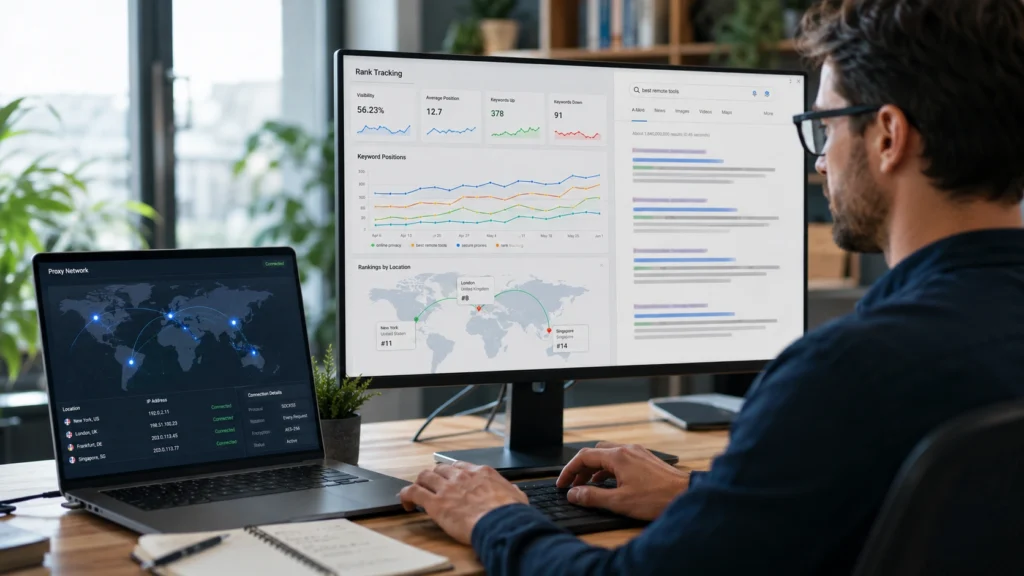
Search results are shaped by context. The same query can produce different rankings depending on where the request comes from, which language is used, whether the result is mobile or desktop, and whether the search engine detects unusual traffic patterns.
For example, a law firm ranking check for “personal injury lawyer” in New York is not the same as the same query from Chicago. A restaurant keyword in Mumbai can change by neighborhood. A SaaS comparison term may look different from the United States compared with the United Kingdom because the search engine may boost local review sites, country specific pricing pages, or regional competitors.
Proxies help solve the location problem by routing requests through IP addresses associated with the target market. If you want to check rankings in Los Angeles, you should not depend only on a server located in Virginia. If you want to track UK search visibility, using an Indian server IP may create noisy data. The closer your request environment is to the real searcher, the more useful your rank tracking becomes.
There are four major proxy types used in SEO rank tracking.
| Proxy Type | Best For | Strength | Limitation |
|---|---|---|---|
| Residential proxies | Local and national rank tracking | Real ISP based IPs | Higher cost per GB |
| Mobile proxies | Mobile SERP checks and app related searches | Strong mobile network signal | Expensive and slower |
| ISP proxies | Stable recurring rank checks | Fast and reliable | Less flexible location coverage |
| Datacenter proxies | Low sensitivity tracking and testing | Cheap and fast | Easier to detect and less local |
For most professional SEO tracking, residential and ISP proxies are the safest starting points. Residential proxies are strong for location based checks because they come from real internet service providers. ISP proxies are useful when you need stable, fast, repeatable checks from a known country or region. Mobile proxies are best when mobile network behavior matters, but they are usually too costly for broad daily keyword tracking.
The biggest mistake is choosing proxies only by price. Cheap proxies can create false SEO reports. If the IP location is wrong, the search result page is incomplete, or the search engine serves a challenge page instead of normal results, your ranking data becomes unreliable.
How Proxy Based Rank Tracking Works
A proxy based rank tracking workflow has five moving parts.
First, the system selects a keyword, such as “best accounting software for small business.” Second, it assigns a target search environment, such as Google United States, English language, desktop results, and New York location. Third, it sends the search request through a proxy that matches that environment. Fourth, it parses the search result page or receives structured results from a SERP provider. Fifth, it stores the ranking positions, URLs, SERP features, and timestamp.
The proxy does not do the ranking analysis by itself. It only controls the network origin of the request. Your rank tracker still needs clean keyword management, location settings, parsing logic, deduplication, and validation.
A professional rank tracking record should include these fields:
| Field | Example |
|---|---|
| Keyword | best residential proxies |
| Search engine | |
| Country | United States |
| City | New York |
| Language | English |
| Device | Desktop |
| Proxy type | Residential |
| Target domain | example.com |
| Ranking URL | https://example.com/page |
| Organic position | 4 |
| SERP features | People Also Ask, video, shopping |
| Timestamp | 2026 06 18 09:30 |
| Status | Success |
This structure matters because rankings are historical data. You are not only checking today’s position. You are building a record that helps you understand movement, volatility, competitor changes, content updates, and local visibility.
Step by Step Implementation Part 1
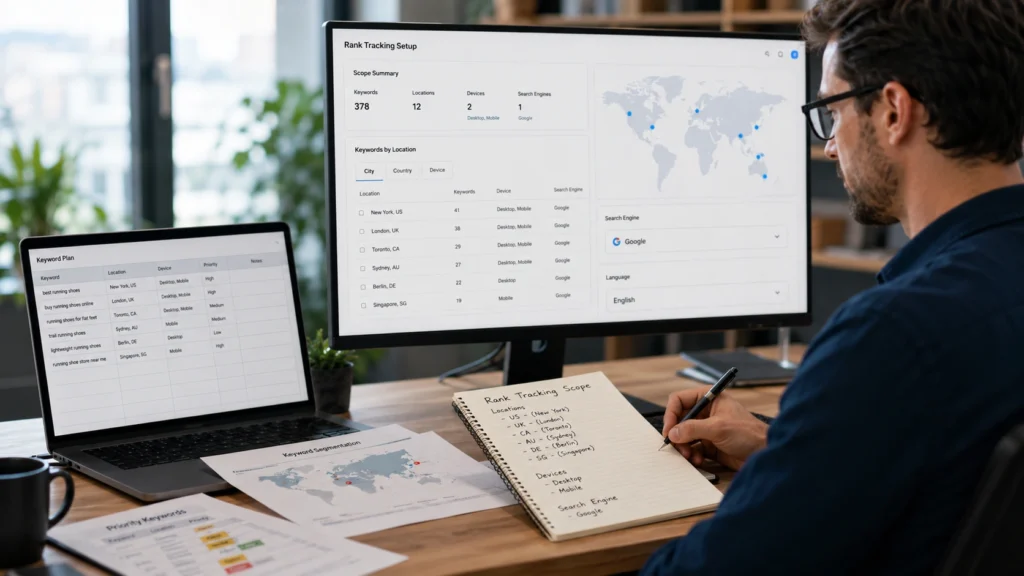
Step 1: Define the Rank Tracking Scope Before Choosing Proxies
Do not start by buying proxies. Start by defining what you need to measure.
A local SEO agency tracking 500 keywords across 40 cities needs a different setup from an affiliate site tracking 2,000 national keywords once per day. An ecommerce brand tracking product terms in five countries needs country level coverage and clean language settings. A SaaS company tracking comparison keywords may care more about desktop organic results, review sites, ads, and featured snippets.
Your scope should answer these questions:
- Which search engine are you tracking?
- Which countries, cities, or regions matter?
- Are you tracking desktop, mobile, or both?
- How often do rankings need to update?
- How many keywords will run per day?
- Do you need organic results only, or SERP features too?
- Will you use a SERP API, browser automation, or your own parser?
For a small business, daily tracking may be enough. For high value ecommerce or affiliate keywords, you may track important terms every 6 to 12 hours. For local SEO, weekly checks may be acceptable if the goal is trend visibility rather than hourly changes.
The pitfall here is overtracking. Checking every keyword from every city every hour sounds impressive, but it quickly becomes expensive and noisy. Focus on business value first. Track money keywords, branded terms, competitor terms, and location terms that actually influence decisions.
Step 2: Choose the Right Proxy Type for Rank Accuracy
Once the scope is clear, choose proxies based on the ranking environment.
For national rank tracking, ISP or residential proxies usually work well. You can assign country level proxies and combine them with language and search parameters. For local rank tracking, residential proxies with city targeting are often better because the IP location needs to match the market more closely. For mobile rankings, mobile proxies can be useful, but many teams use mobile user agents with residential proxies for early testing before moving to true mobile networks.
A basic decision table looks like this:
| Tracking Goal | Recommended Proxy | Notes |
|---|---|---|
| Country level organic rankings | ISP or residential | Good balance of speed and accuracy |
| City level local rankings | Residential with city targeting | Better for local SERP variation |
| Mobile SERP checks | Mobile or residential plus mobile user agent | True mobile proxies cost more |
| High volume testing | Datacenter or ISP | Use only for low sensitivity checks |
| Map pack tracking | Residential with precise location signals | Needs careful geo setup |
Do not mix proxy types randomly inside one report. If Monday’s ranking is checked through a residential IP in Dallas and Tuesday’s through a datacenter IP in another state, the ranking change may not reflect SEO movement. It may simply reflect a different measurement environment.
For clean reporting, keep the proxy class consistent per keyword group. If you track “plumber in Austin” using Austin residential proxies, continue using the same proxy strategy for that group over time.
Step 3: Configure Search Location, Language, and Device Signals
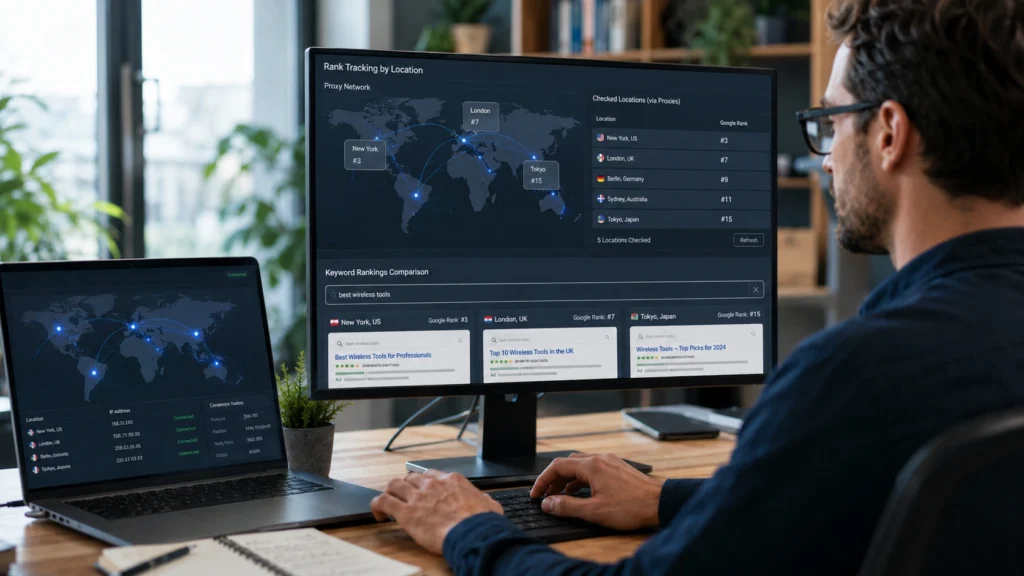
A proxy alone is not enough. You also need to control the search settings.
For Google style tracking, location and language are commonly influenced through country, language, device type, browser settings, and URL parameters where supported. For example, country targeting may use a two letter country value, language may use an interface language value, and device type may be simulated through browser viewport and user agent.
A typical rank tracking request configuration may include:
| Signal | Example Setting | Purpose |
|---|---|---|
| Proxy country | US | Matches target market |
| Proxy city | New York | Supports local result accuracy |
| Language | en | Requests English interface |
| Device | Desktop or mobile | Separates mobile and desktop rankings |
| Browser viewport | 390 x 844 for mobile | Helps simulate mobile layout |
| Search depth | Top 100 results | Defines how far to parse |
| Safe search | Fixed setting | Keeps results consistent |
If you use browser automation, configure the viewport and user agent consistently. Do not run one check as desktop and another as mobile unless that is intentional.
Example Playwright concept:
from playwright.sync_api import sync_playwright

proxy_config = {
    "server": "http://proxy.provider.com:8000",
    "username": "user",
    "password": "pass"
}

with sync_playwright() as p:
    browser = p.chromium.launch(
        headless=True,
        proxy=proxy_config
    )

    context = browser.new_context(
        viewport={"width": 1366, "height": 768},
        locale="en-US"
    )

    page = context.new_page()
    page.goto("https://www.google.com/search?q=best+crm+software", timeout=60000)

    html = page.content()
    print(html[:500])

    browser.close()
This is only the basic skeleton. A production tracker should include error handling, consent page handling where lawful, status checks, result parsing, and validation before saving data.
Step 4: Build a Clean Keyword and Location Matrix
The most reliable rank trackers are organized before the first request is sent. Create a matrix that connects keywords with locations, devices, and tracking frequency.
| Keyword Group | Location | Device | Frequency |
|---|---|---|---|
| Brand keywords | National | Desktop and mobile | Daily |
| Money keywords | Top target cities | Desktop and mobile | Daily |
| Blog keywords | National | Desktop | Weekly |
| Local service terms | City level | Mobile | Daily |
| Competitor terms | National | Desktop | Weekly |
This prevents duplicate checks and wasted proxy traffic. It also makes reporting easier because every ranking movement can be tied to a specific search environment.
At this point, your foundation is ready: you know what you are tracking, which proxy type matches the job, how location and device signals will be handled, and how keyword groups will be organized. The second half of the guide will cover request scheduling, parsing SERP results, storing rankings, handling errors, optimizing costs, troubleshooting inaccurate rankings, and building FAQs around proxy based SEO rank tracking.
Step 5: Schedule Rank Checks Without Creating Noisy Data
Once your keyword and location matrix is ready, the next step is scheduling. This is where many rank tracking systems become unreliable. They either check too often, use inconsistent proxy locations, or run all keywords at the same time and create artificial instability in the data.
A clean schedule should match the business value of the keyword. Branded keywords and high intent money terms can be checked daily. Broader blog keywords may only need weekly checks. Local service keywords should usually be checked at the same time of day because local SERPs can shift based on availability, intent patterns, ads, and map pack changes.
For most professional SEO teams, this setup works well:
| Keyword Type | Tracking Frequency | Proxy Requirement |
|---|---|---|
| Branded keywords | Daily | Country level proxy |
| Core money keywords | Daily | Country or city level proxy |
| Local service keywords | Daily or 3 times weekly | City level residential proxy |
| Informational blog keywords | Weekly | Country level proxy |
| Competitor comparison keywords | Weekly | Stable ISP or residential proxy |
| High value affiliate keywords | Daily | Country specific residential proxy |
Avoid running thousands of searches from the same proxy session in a short window. Even if the proxy provider allows it, search engines may return inconsistent results, temporary challenges, or incomplete pages. Use controlled batches, randomize the order of keywords, and keep enough delay between requests.
A good starting point is 5 to 15 seconds between rank checks per proxy session, with lower concurrency for location sensitive tracking. If you are using a SERP API, the provider handles much of this infrastructure. If you are building your own tracker, you need to manage pacing, retries, session control, and error logging yourself.
Step 6: Parse SERP Results Carefully and Store More Than Position
Rank tracking is not only about finding whether your domain appears at position 1, 5, or 20. Modern search pages contain ads, map packs, People Also Ask boxes, videos, shopping modules, image blocks, AI summaries in some regions, and other SERP features. If your parser treats every visible block as a normal organic result, your reports will be wrong.
Your parser should separate result types clearly:
| SERP Element | Should It Count as Organic Rank? | Notes |
|---|---|---|
| Paid ads | No | Track separately if useful |
| Organic results | Yes | Main ranking data |
| Map pack | Separate | Important for local SEO |
| People Also Ask | Separate | Useful for content opportunities |
| Video results | Separate | Often affects visible CTR |
| Shopping results | Separate | Useful for ecommerce |
| Featured snippet | Yes, but mark separately | Can change click behavior |
For organic ranking, store both the position and the exact ranking URL. This matters because a domain may rank with different pages over time. If your homepage ranked last week and a blog post ranks this week, the average position alone does not tell the full story.
A clean rank record should store:
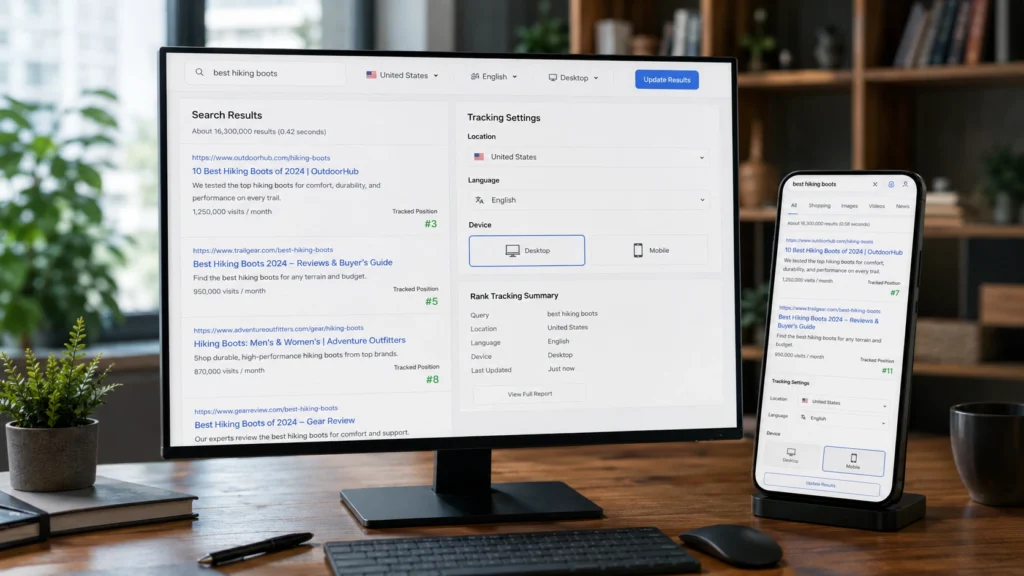
| Data Point | Example |
|---|---|
| Keyword | best vpn for travel |
| Search location | United States |
| Device | Mobile |
| Organic position | 7 |
| Ranking URL | https://example.com/best-vpn-travel |
| Page title | Best VPN for Travel |
| SERP features present | PAA, video, ads |
| Proxy session | US residential session |
| Checked at | 2026 06 18 10:00 |
| Result status | Valid |
Also store failed checks. If you only store successful checks, your reporting will hide technical issues. A skipped or failed rank check should be visible in your system so you do not mistake missing data for ranking loss.
Step 7: Validate Results Before Reporting Rankings
A rank tracker must verify that the page it collected is actually a search result page. A request can return a consent page, CAPTCHA page, blank page, redirect, blocked response, or localized page that does not match the intended market.
Validation protects your SEO reports from bad data.
At minimum, check for these conditions before saving a result as valid:
| Validation Check | Why It Matters |
|---|---|
| Search results container exists | Confirms the SERP loaded |
| Expected language appears | Confirms language targeting |
| Organic result blocks are present | Prevents empty or blocked pages |
| No challenge page detected | Avoids false ranking drops |
| Proxy country matches target country | Protects location accuracy |
| HTTP status is successful | Catches network level errors |
Do not assume HTTP 200 means the rank check worked. A search engine can return a normal status code while showing a page that is not usable for ranking analysis. Your parser should flag these cases and retry later with a clean session.
For high value reports, add manual spot checks. Take a small sample of keywords, locations, and devices, then compare the stored result against a live browser check from the same market. This will not match perfectly every time, but it helps you catch broken parsers, wrong locations, or bad proxy routing early.
Advanced Optimization Tips for Proxy Based Rank Tracking
The first optimization is consistency. Use the same proxy type, location method, device profile, and parsing logic for each keyword group over time. Ranking reports are only useful when the measurement method is stable.
The second optimization is location precision. For national tracking, country level proxies may be enough. For local SEO, city level residential proxies are better. For map pack tracking, proxy location alone may not always be enough, so you may also need consistent search parameters, browser location permissions where appropriate, and careful separation between organic and local pack results.
The third optimization is session management. Do not rotate IPs in the middle of a single keyword check. Use one proxy session to load one search result page, parse it, validate it, and close it. For pagination beyond page one, keep the same session so the results remain consistent.
The fourth optimization is cost control. Browser based tracking uses more bandwidth than simple HTTP requests. If you do not need JavaScript rendering, avoid full browser automation. If you use Playwright, block unnecessary images, fonts, and media files when it does not affect result accuracy.
The fifth optimization is smart sampling. Not every keyword needs daily checks across every city. Group keywords by revenue impact, volatility, and client reporting needs. This keeps proxy costs under control and makes your reports easier to understand.
Troubleshooting Common Proxy Rank Tracking Issues
If rankings look wildly different every day, check whether the proxy location is changing too much. A keyword tracked from different cities or different proxy types will naturally return different results. Keep the environment stable before blaming an SEO update.
If many checks return no ranking for a domain that should rank, inspect the raw SERP HTML. Your parser may be broken, the result layout may have changed, or the page may be ranking under a different URL than expected.
If you see frequent blocked or challenge pages, reduce request volume, increase delays, rotate sessions more carefully, and review whether your tracking method follows the search engine’s rules. Do not keep retrying the same keyword aggressively. That usually creates more bad data.
If local rankings look inaccurate, verify the IP location with an independent IP check. Some proxies advertise country or city targeting, but the actual detected location may not match your report needs.
If mobile and desktop rankings are mixed together, separate them at the database level. Mobile and desktop results can differ, especially for local searches, ecommerce queries, and SERPs with heavy visual features.
FAQs About Using Proxies for SEO Rank Tracking
What type of proxy is best for SEO rank tracking?
Residential proxies are usually best for local and country specific rank tracking because they use ISP assigned IPs. ISP proxies are strong for stable national tracking. Mobile proxies are useful for mobile first checks but are usually more expensive.
Can I track Google rankings without proxies?
Yes, but the data may be limited or inaccurate if you only check from one server location. Proxies help when you need rankings from specific countries, cities, or device environments.
Are datacenter proxies good for rank tracking?
Datacenter proxies can work for low sensitivity checks, testing, and some national tracking. For local SEO or accurate market specific reporting, residential or ISP proxies are usually more reliable.
How often should I track rankings?
Daily tracking is enough for most important keywords. Weekly tracking works for informational content. Very high value keywords can be checked more often, but excessive tracking can increase cost and noise.
Should I use a SERP API or build my own proxy based tracker?
A SERP API is easier and often more stable because the provider handles proxies, parsing, and scaling. Building your own tracker gives more control, but you must manage proxies, validation, parsing, storage, and compliance yourself.
Why do my rankings differ from what I see manually?
Manual searches may be affected by your location, browser history, language, device, signed in state, and live SERP variation. Proxy based tracking gives you a controlled measurement environment, but it may still differ from a personal manual search.
Do proxies guarantee accurate rank tracking?
No. Proxies improve location and access control, but accuracy depends on the full setup: proxy quality, search parameters, device simulation, parser quality, validation, scheduling, and data storage.
Final Takeaway
Using proxies for SEO rank tracking is about building a controlled measurement system. The proxy gives you location and network control, but the real accuracy comes from consistent settings, clean keyword grouping, careful parsing, and strong validation.
Start with a small keyword set. Track one country or city first. Confirm that the proxy location is correct. Validate the SERP output. Store the ranking URL, not just the position. Then scale your setup across more keywords, devices, and locations.
That is how proxy based rank tracking becomes useful for real SEO decisions instead of just another noisy dashboard.