
IPRoyal sits in an interesting place in the proxy market. It is not trying to look like Bright Data or Oxylabs with an enterprise-heavy platform and a huge 100M+ residential pool. It is also not a bare-bones proxy seller with weak targeting and unreliable IPs. The real appeal of IPRoyal is that it gives smaller teams, affiliate marketers, SEO users, automation builders, and growing data projects access to practical proxy infrastructure without the painful entry cost usually attached to premium providers.
The quick verdict is simple: IPRoyal is a strong choice if you want affordable residential, datacenter, ISP, mobile, and AI-assisted unblocking tools in one dashboard. It is best for users who need real proxy control but do not want to start with enterprise contracts or complicated onboarding. If your work includes local SERP tracking, eCommerce price monitoring, ad verification, travel fare aggregation, review scraping, marketplace research, sneaker automation, or competitor monitoring, IPRoyal gives you a flexible setup at a much friendlier scale.
That said, it is important to set the right expectation. IPRoyal’s residential proxy pool is listed at 32M+ IPs across 195+ countries. That is large enough for many business and scraping use cases, but it is smaller than the mega pools offered by Bright Data and Oxylabs.
For most users, that may not be a problem. A good proxy decision is not only about who has the biggest number on the homepage. It is about whether the provider gives you enough usable IPs, accurate targeting, clean sessions, strong protocol support, and stable performance for your specific workflow.
Where IPRoyal works well is in day-to-day scraping and automation tasks. A content publisher can use it to check localized Google results. An affiliate marketer can verify advertiser landing pages by country. An eCommerce researcher can monitor public product pages and prices. A travel data project can compare fares across regions. A developer can plug proxies into Python, Node.js, Puppeteer, Playwright, Selenium, Scrapy, or a no-code scraping tool.
IPRoyal is not perfect for every buyer. If you need the deepest enterprise compliance stack, fully managed datasets, or the largest residential pool in the industry, a higher-end provider may make more sense. But if you want a practical, affordable, easy-to-control proxy provider that covers the main proxy types, IPRoyal deserves serious attention.
IPRoyal Core Infrastructure: Proxy Pool, Locations, and Performance
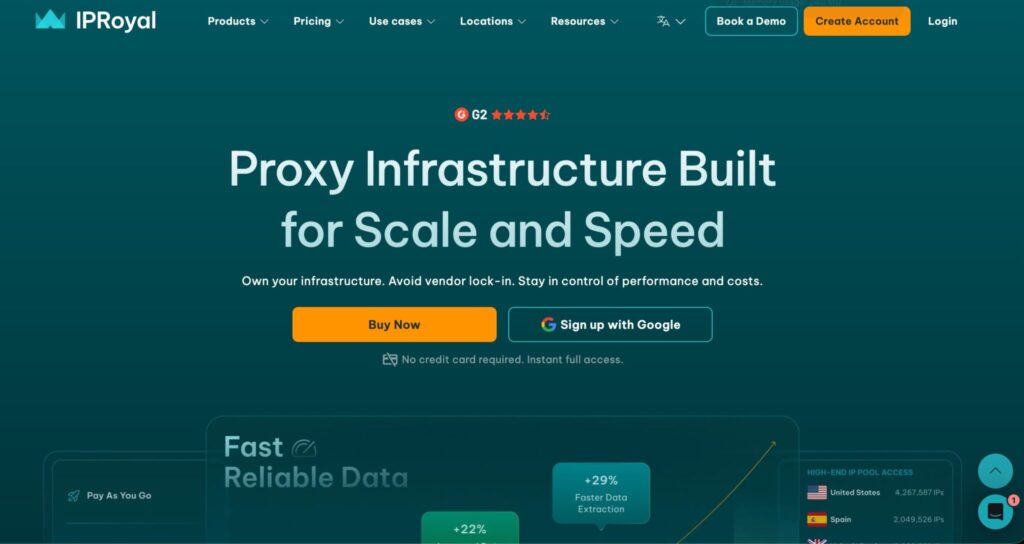
IPRoyal’s infrastructure is built around multiple proxy types rather than one oversized product. Its residential proxy network is the main entry point for most users, with 32M+ residential IPs in 195+ countries. These are real household IPs, which makes them better suited for websites that are more likely to challenge or block datacenter traffic.
Residential proxies are useful because they look closer to normal user traffic. For example, if you are scraping public product pages from an eCommerce website, the site may treat requests from a datacenter IP with more suspicion. A residential IP from a regular ISP often has a better trust profile, especially when paired with proper rotation, realistic request pacing, and clean scraper behavior.
IPRoyal also supports country, state, and city-level targeting on residential proxies. That matters for any use case where location changes the result. Local SEO rankings can shift by city. Retail prices can vary by region. Ads may appear in one country but not another. Travel fares and hotel availability can change based on visitor location. A generic proxy from “somewhere in the United States” is not enough when the data needs to reflect Chicago, Dallas, Los Angeles, or Miami.
Performance claims are competitive for the price category. IPRoyal lists a 99.4% success rate and around 0.5 second response time for its residential proxies. The provider also supports rotating and sticky sessions, HTTP(S), and SOCKS5. In the documentation, IPRoyal notes that users can get a new IP on each request or keep a sticky session for up to 7 days. That longer sticky window is useful when a workflow needs continuity rather than constant rotation.
The datacenter network is built for a different job. IPRoyal’s datacenter proxies are dedicated, support 60+ locations, include HTTP(S) and SOCKS5 protocols, and support state and city-level targeting. The company describes these proxies as suitable for web scraping, testing, and automation at scale. It also highlights unlimited sessions and 99.9% uptime for datacenter projects. One practical detail worth noting is that datacenter proxies include traffic under a fair usage model, with 100GB per proxy per monthly cycle before speed reduction applies.
IPRoyal also offers ISP proxies, mobile proxies, and Web Unblocker. ISP proxies are static residential-style IPs that combine datacenter-like stability with better trust than ordinary datacenter IPs. Mobile proxies use carrier networks and are useful for mobile ad verification, social media workflows, app testing, and mobile SERP checks. Web Unblocker is IPRoyal’s newer AI-powered product for scraping harder websites where basic proxy rotation may not be enough.
IPRoyal Product Breakdown: Residential, Datacenter, and Web Unblocker
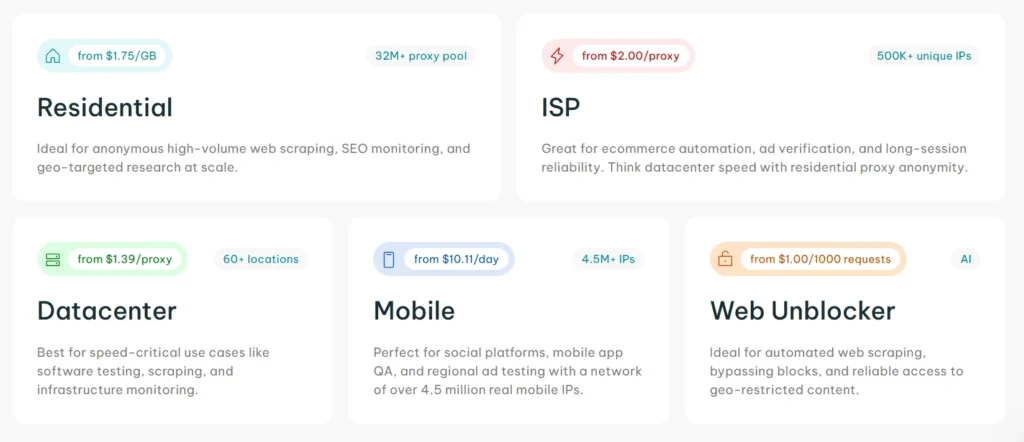
IPRoyal’s product lineup is easier to understand when you separate it by use case. Residential proxies are for trust and geo accuracy. Datacenter proxies are for speed and control. Web Unblocker is for difficult websites with anti-bot systems. ISP and mobile proxies fill the gaps when a project needs static sessions or mobile carrier identity.
IPRoyal Residential Proxies
IPRoyal Residential Proxies are the best starting point for most scraping and research tasks. They are designed for users who need access to public websites without relying on easily flagged datacenter IPs. The 32M+ IP pool, 195+ country coverage, rotating sessions, sticky sessions, and city-level targeting make this product useful for SEO, affiliate research, ad verification, and public market data collection.
The session control is one of the more useful features. Rotating sessions let you switch IPs frequently, which helps when collecting many pages from the same website. Sticky sessions let you keep the same IP for longer, which helps when the website expects continuity. For example, checking a checkout flow, maintaining a cart, viewing localized pages across multiple steps, or monitoring a session-based experience usually works better with a sticky IP than a new IP every request.
The technical setup is also friendly. IPRoyal supports username and password authentication as well as IP whitelisting. That means you can use it with common scraping tools, browser automation frameworks, proxy managers, and custom scripts without much friction. HTTP(S) and SOCKS5 support also gives developers enough protocol flexibility for most normal workflows.
IPRoyal Datacenter Proxies
IPRoyal Datacenter Proxies are a better fit when speed, stability, and lower cost per task matter more than residential trust. These proxies come from dedicated server infrastructure, which usually makes them faster and more predictable than residential connections.
Datacenter proxies are useful for scraping less protected public websites, testing software, monitoring uptime, checking public databases, running brand monitoring jobs, and handling automation tasks where the target does not aggressively block server IP ranges. Because IPRoyal sells dedicated datacenter proxies, the IP is not shared randomly with many unknown users. That gives you better control over reputation and consistency.
The tradeoff is detection risk. Datacenter IPs are easier for some websites to identify because they come from server networks rather than household ISPs. For lightweight tasks, that may not matter. For heavily protected eCommerce, ticketing, travel, or social platforms, residential proxies or Web Unblocker will usually be the safer option.
IPRoyal Web Unblocker as the Next-Gen Residential Layer
IPRoyal does not market a product literally called “Next-Gen Residential Proxies.” Its closest equivalent is Web Unblocker, which is an AI-powered proxy solution built for difficult scraping targets. This is where IPRoyal moves beyond raw IP access.
A normal proxy only changes how your request is routed. It does not automatically solve CAPTCHAs, manage browser fingerprints, retry failed requests, select better IPs, or adjust headers. Web Unblocker is designed to handle those extra problems. IPRoyal describes it as an advanced proxy solution for bypassing CAPTCHAs, Cloudflare, geo-blocks, and other anti-bot systems.
This matters because modern websites do not rely only on IP blocking. They look at headers, cookies, TLS patterns, browser behavior, request timing, and session consistency. A raw residential proxy may still fail if the scraper looks unnatural. Web Unblocker helps by managing IP selection, retries, fingerprint rotation, CAPTCHA handling, and geo targeting inside one automated layer.
For teams scraping public eCommerce pages, travel listings, SERPs, marketplaces, stock data, or AI training data sources, this can reduce engineering work. Instead of maintaining a complex proxy rotation system, your scraper sends requests through the Web Unblocker endpoint and lets IPRoyal handle more of the access logic.
IPRoyal Proxy Features and Technical Specs
| Product | Best For | Network and Coverage | Session Control | Protocols and Technical Specs | Practical Use Cases |
|---|---|---|---|---|---|
| Residential Proxies | Web scraping, SEO tracking, ad verification, price monitoring | 32M+ residential IPs across 195+ countries | Rotating IPs and sticky sessions up to 7 days | HTTP(S), SOCKS5, username/password auth, IP whitelisting, unlimited simultaneous sessions | Local SERP checks, eCommerce scraping, travel fare tracking, affiliate landing page verification |
| Datacenter Proxies | Fast scraping, testing, automation, lower-cost monitoring | 60+ datacenter locations with state and city-level targeting | Dedicated IP usage with unlimited sessions | HTTP(S), SOCKS5, TCP and UDP connections, API support, 99.9% uptime claim, fair usage traffic model | Public website crawling, QA testing, brand monitoring, software automation |
| Web Unblocker | Difficult websites with CAPTCHAs, Cloudflare, and anti-bot checks | Uses IPRoyal’s global residential infrastructure across 195 countries | Automated IP selection, retries, CAPTCHA handling, and fingerprint rotation | AI-powered unblocking, smart headers, dynamic browser fingerprinting, simple HTTP-style integration | Protected eCommerce pages, SERP scraping, marketplace monitoring, AI data collection |
| ISP Proxies | Static sessions with residential-style trust | 500K+ unique ISP IPs | Static IP usage for stable identity | Residential-style IPs with datacenter-like speed and reliability | Account testing, long-session scraping, marketplace workflows |
| Mobile Proxies | Mobile-first testing, mobile ads, app research | 4.5M+ mobile IPs from real carrier networks | Custom IP rotation and dedicated mobile options | HTTP, HTTPS, SOCKS, carrier-based mobile infrastructure, around 0.8s response time | Mobile SERP checks, ad verification, social media management, mobile app testing |
The main takeaway is that IPRoyal gives users a balanced proxy stack without forcing them into enterprise complexity. Residential proxies cover the trust-sensitive scraping jobs. Datacenter proxies cover fast and stable tasks. ISP proxies help when long sessions matter. Mobile proxies are useful when you need real carrier identity. Web Unblocker gives IPRoyal a more advanced option for websites where simple proxy rotation is not enough.
For the first half of this review, that is the key story. IPRoyal may not have the largest proxy pool in the world, but it has enough infrastructure, enough location control, and enough product variety to serve a wide range of real-world scraping and automation projects.
IPRoyal Pricing: Affordable Entry Points With Flexible Proxy Options
IPRoyal’s pricing is one of its biggest selling points. It is not positioned like a premium enterprise provider where you need a large monthly commitment before testing the platform. Most of its proxy products are easy to buy directly, which makes it attractive for small teams, affiliate marketers, SEO users, developers, automation builders, and growing data projects that want control without heavy contracts.
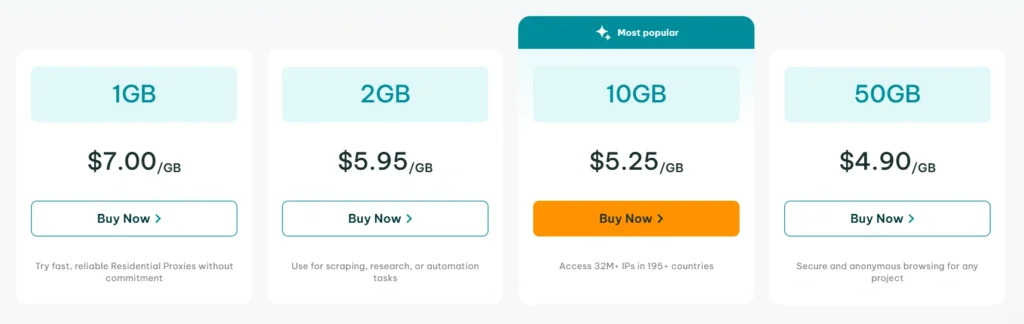
Residential proxies start from $1.75 per GB on IPRoyal’s main pricing page, although the residential pricing table also shows smaller pay as you go bundles starting at 1GB with higher per GB rates. The key benefit is that residential traffic does not expire. That matters for smaller users because you are not forced to burn through unused bandwidth before the end of the billing cycle. If you only need proxies for keyword checks, occasional eCommerce scraping, advertiser verification, or monthly competitor research, non-expiring traffic can make the real cost much easier to manage.
For higher volume buyers, the per GB cost drops as the bandwidth package increases. That gives IPRoyal a practical middle ground. You can start small, test the quality, then scale traffic once you know the IP pool works for your target sites. This is especially useful for scraping projects where the first challenge is not price, but success rate. A cheap proxy plan is useless if it fails on the websites you actually need.
Datacenter proxies start from $1.39 per proxy on longer duration plans. The 30-day option starts higher, while 60-day and 90-day plans reduce the monthly cost per proxy. This pricing is simple and useful for users who need fast dedicated IPs for software testing, infrastructure monitoring, simple scraping, account testing, or automation tasks where residential trust is not required.
Static residential proxies, also called ISP proxies, start from short-term access at $1.80 per proxy for 24 hours, with longer monthly options priced higher per proxy depending on duration. These are useful when you need the stability of a fixed IP but want better trust than a normal datacenter proxy. For example, account management, marketplace monitoring, checkout testing, long-session browsing, and ad verification workflows often work better with ISP proxies than fast-rotating residential IPs.
Mobile proxies are more expensive because they use real carrier-grade mobile IPs. IPRoyal lists dedicated mobile plans starting from $10.11 per day and monthly access from $117 per month on longer duration plans. Rotating mobile proxy traffic is also available by bandwidth, with small packages starting at 2GB. These are best for mobile-specific use cases such as mobile SERP checks, app QA, social media management, mobile ad verification, and testing how a website behaves from a real 4G, 5G, or carrier-based environment.
Web Unblocker pricing starts from $1.00 per 1,000 requests. Larger bundles reduce the request cost, with 5,000, 50,000, and 100,000 request packages bringing the rate down. This is a smart pricing model for teams that do not want to pay by bandwidth and would rather pay for scraping attempts through an automated unblocking layer.
| IPRoyal Product | Starting Price | Pricing Model | Best Use Case |
|---|---|---|---|
| Residential Proxies | From $1.75 per GB | Bandwidth based, traffic does not expire | SEO tracking, price scraping, ad verification, public data collection |
| Datacenter Proxies | From $1.39 per proxy | Per proxy by duration | Fast scraping, testing, automation, low-cost monitoring |
| Static Residential Proxies | From $1.80 per proxy for 24 hours | Per proxy by duration | Long sessions, account workflows, marketplace checks |
| Mobile Proxies | From $10.11 per day or $117 per month | Dedicated access or rotating traffic | Mobile ads, app testing, mobile SERPs, social workflows |
| Web Unblocker | From $1.00 per 1,000 requests | Request based | CAPTCHA-heavy pages, Cloudflare checks, protected scraping targets |
IPRoyal vs Competitors: Where It Wins and Where It Falls Short
IPRoyal is best compared against providers like Decodo, SOAX, Webshare, NetNut, Oxylabs, and Bright Data. It does not beat every competitor in raw pool size or enterprise tooling, but it competes strongly on affordability, product variety, and ease of entry.
Compared with Bright Data, IPRoyal is much easier to approach for smaller users. Bright Data has a massive data collection ecosystem, including proxies, datasets, Web Unlocker, scraping APIs, browser tools, and enterprise services. That is powerful, but it can feel heavy if you only need affordable proxies for SEO checks, affiliate research, basic scraping, or automation. IPRoyal is simpler and cheaper to start with, but Bright Data is stronger for enterprise-scale data pipelines.
Against Oxylabs, the difference is similar. Oxylabs has a larger residential pool, stronger enterprise positioning, and a more mature scraping infrastructure stack. IPRoyal wins when the buyer wants lower entry pricing, non-expiring residential traffic, and a dashboard that does not require enterprise onboarding. Oxylabs is better for teams where proxy performance is tied to high-value data products or large scraping systems.
Decodo is probably one of IPRoyal’s closest competitors for small and mid-sized users. Decodo has a very polished product experience, strong residential coverage, scraping tools, and a beginner-friendly dashboard. IPRoyal often appeals more to price-sensitive users who want flexible residential, datacenter, ISP, mobile, and Web Unblocker access from one account. Decodo feels more polished. IPRoyal feels more budget practical.
SOAX is strong for precise targeting and a clean user experience. It can be a better fit when you need more refined location control and a smoother managed proxy experience. IPRoyal is usually better when you care more about cost control and simple pay as you go access.
Webshare is cheaper for datacenter-heavy use cases and very friendly for beginners. But IPRoyal has a broader proxy lineup, including residential, static residential, mobile, and Web Unblocker. For users who may start with datacenter proxies but later need residential or mobile IPs, IPRoyal gives more room to grow.
Who Should Use IPRoyal?
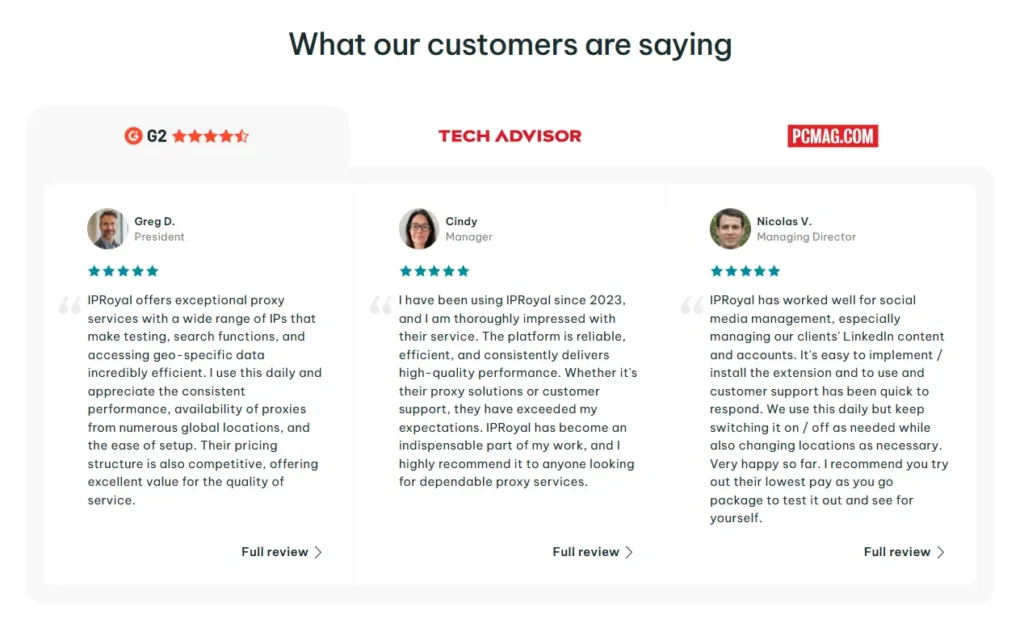
IPRoyal makes the most sense for users who need practical proxy access without enterprise pricing. It is a good match for affiliate marketers checking advertiser landing pages, coupon visibility, geo-based offers, and competitor funnels. It also works well for SEO professionals who need local SERP checks, keyword tracking, rank monitoring, and search result comparison across cities or countries.
For eCommerce teams, IPRoyal can support price monitoring, product availability tracking, marketplace research, review monitoring, and catalog checks. Residential proxies are usually the better choice for these workflows, while Web Unblocker can help when product pages trigger CAPTCHAs or advanced blocking systems.
Developers and automation teams can use IPRoyal for testing, QA, scraping, browser automation, and internal monitoring. Datacenter proxies are the most cost-effective choice for lightweight targets, while ISP proxies are better for stable sessions.
IPRoyal is also useful for social media managers and app testing teams, especially through mobile and static residential proxies. Mobile IPs are expensive compared with residential or datacenter proxies, but they are more realistic for mobile-first testing and ad verification.
IPRoyal Pros and Cons
Pros:
• Affordable starting prices compared with enterprise proxy providers
• Residential traffic does not expire, which helps small users manage costs
• Good product variety, including residential, datacenter, ISP, mobile, and Web Unblocker
• 32M+ residential IP pool across 195+ countries
• Sticky residential sessions up to 7 days
• HTTP(S) and SOCKS5 support across major proxy types
• Datacenter proxies offer strong speed and low per proxy pricing
• Web Unblocker adds an automated option for harder scraping targets
Cons:
• Residential pool is smaller than Bright Data and Oxylabs
• Not as feature-rich as enterprise data platforms
• Advanced teams may miss managed datasets and dedicated scraping APIs
• Mobile proxies can become expensive for long-term projects
• Support and performance may vary depending on target sites and use case
• Best results still require proper scraper setup, pacing, and session management
Final Verdict: Is IPRoyal Worth It?
IPRoyal is worth it if you want a flexible, affordable proxy provider with enough product depth for real scraping, SEO, affiliate research, and automation work. It is not the biggest proxy network in the industry, and it is not trying to be the most advanced enterprise data platform. Its real strength is practical accessibility.
For small businesses, affiliate marketers, solo developers, SEO teams, and mid-sized scraping projects, IPRoyal gives you a lot to work with. Residential proxies cover location-sensitive public data tasks. Datacenter proxies are fast and affordable. ISP proxies are useful for stable sessions. Mobile proxies help with mobile-first workflows. Web Unblocker gives you a stronger option when normal proxy rotation is not enough.
The best way to choose IPRoyal is to match the proxy type to your task. Use residential proxies for trust and geo accuracy. Use datacenter proxies for speed and low-cost crawling. Use ISP proxies for long sessions and account workflows. Use mobile proxies when carrier identity matters. Use Web Unblocker when you are dealing with CAPTCHAs, Cloudflare, retries, and stronger anti-bot checks.
Overall, IPRoyal is a strong value-focused proxy provider. It is best for users who want reliable proxy access without paying enterprise-level prices. If your project needs the largest possible pool, fully managed datasets, or advanced enterprise support, Bright Data or Oxylabs may be a better fit. But for most cost-conscious scraping, SEO, and affiliate use cases, IPRoyal is easy to recommend.